
College website development in 2026 is not what it was in 2022. AI Overviews now answer roughly 47% of higher-ed research questions without a click per BrightEdge's 2025 SERP data. Federal Title II accessibility rules come into force in April 2026. And Gen Z applicants make a shortlist in under seven minutes on mobile per RNL's 2025 E-Expectations report. A college website built to the old spec is a college website losing enrollment. Here is what a modern college website actually is.
What defines a modern college website in 2026?
A college website in 2026 is a fast, accessible, AI-cited answer engine for prospective students and a governance-safe publishing platform for the fifty to five hundred people who edit it. It is not a brochure. It is not a design showcase. It is the primary enrollment tool.
How much does college website development cost?
For a mid-sized public or private college (2,000 to 15,000 FTE), a full rebuild in 2026 typically runs $85,000 to $340,000 depending on program-page count, integrations, and accessibility scope. Small colleges under 2,000 FTE can rebuild for $45,000 to $95,000 on WordPress. Large systems above 20,000 FTE routinely spend $500,000 to $1.4 million on multi-year Drupal or headless programs.
How long does a college website rebuild take?
A focused rebuild on WordPress with 40 to 80 program pages runs 12 to 16 weeks. Drupal with SIS integration and 200+ program pages runs 6 to 10 months. Anything a vendor quotes at "four weeks" is either a template swap or a project that will land in year two.
Which CMS wins for colleges in 2026?
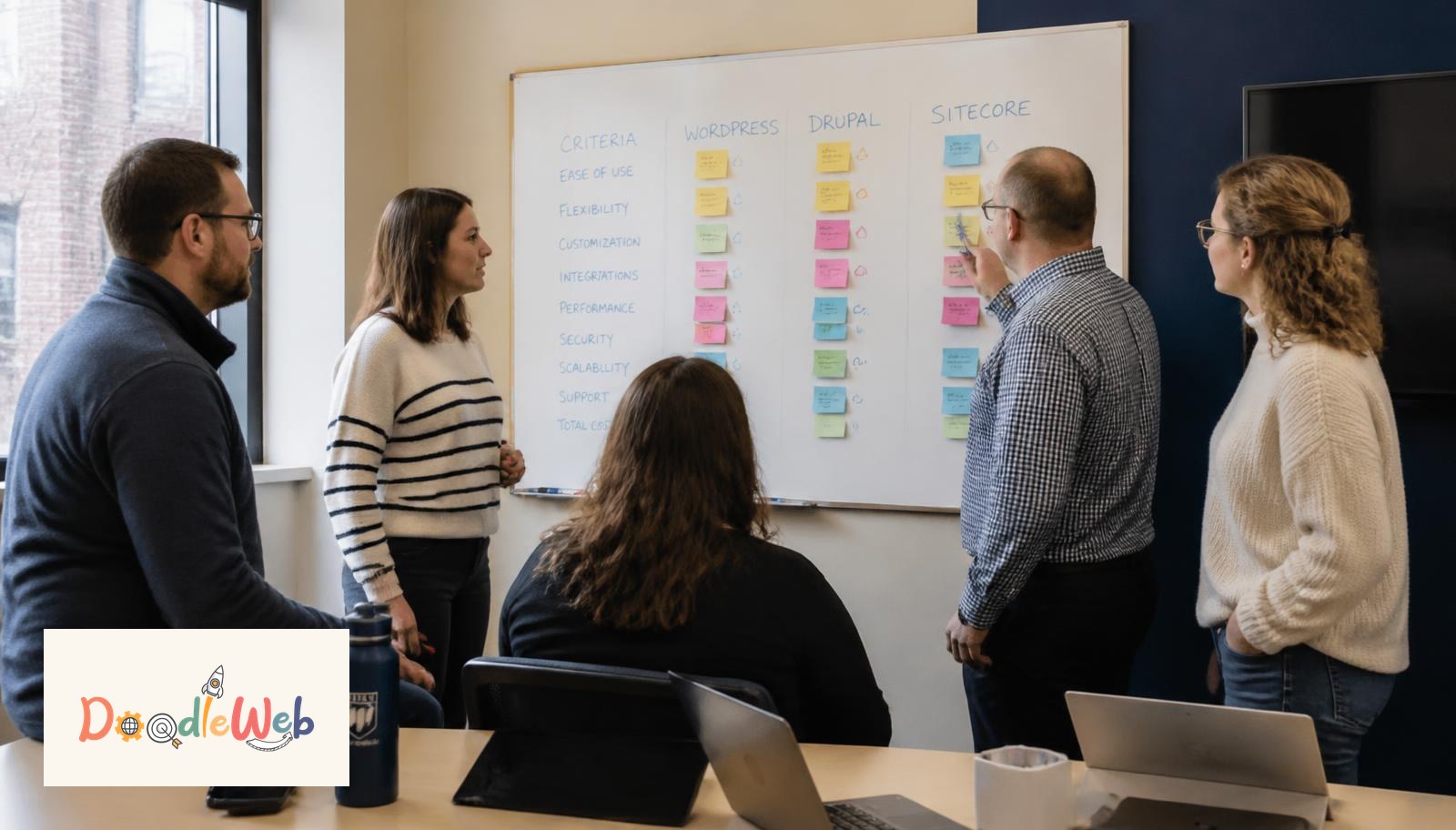
Three platforms cover 90% of the market. WordPress fits small to mid colleges and marketing-led teams. Drupal fits public and mid-to-large private colleges with strict governance and multilingual needs. Webflow fits small liberal-arts colleges under 3,000 FTE with a designer-led team and no SIS integration.
What must a college website include to be AI-cited in 2026?
Answer-first program pages that state credits, format, cost, and outcomes in the first two sentences. EducationalOccupationalProgram and FAQPage JSON-LD on every program. A stable canonical URL for each program. Consistent facts across the website, Common App, and College Scorecard. Third-party citations on the sites AI assistants read.
What are the accessibility requirements for colleges in 2026?
Public colleges and public community colleges must conform to WCAG 2.2 AA by April 24, 2026 (for entities over 50,000 population served) or April 26, 2027 (for smaller entities). Private nonprofit colleges are also covered under Section 504 and ADA Title III. Practically, this means captioning every video, remediating every PDF, and running automated accessibility tests in CI on every deploy.
What is the biggest mistake colleges make in a rebuild?
Skipping the content audit. Most colleges bring 4,000 to 12,000 pages into a rebuild. Fewer than 800 get meaningful traffic. Publishing everything in the new CMS on day one triples the maintenance load, dilutes SEO authority, and forces the team to write new content on top of a broken taxonomy. Cut ruthlessly before you rebuild.
What is the fastest path to enrollment lift after launch?
Rewrite the top of the top 40 program pages to answer the applicant's question in the first sentence. Add EducationalOccupationalProgram JSON-LD to every program. Ship a real-page thank-you after RFI submission. Instrument the funnel end to end. These four changes typically move applications 8 to 22% in a single cycle.
Where to go next
The right way to sequence a college website project is (1) discovery and content audit, (2) platform decision using the platform decisions framework, (3) design system and program-page template, (4) migration and integration, (5) accessibility remediation, and (6) post-launch measurement.
Read the companion pieces on 9 website development factors, 7 features colleges need, and why university websites get slow, or book a free audit.
Seattle agency · Seattle, WA
A full-service digital agency working in WordPress, Drupal, Shopify, Webflow, React, and React Native. We partner with universities, nonprofits, governments, and growing brands to ship sites that hold up after launch.