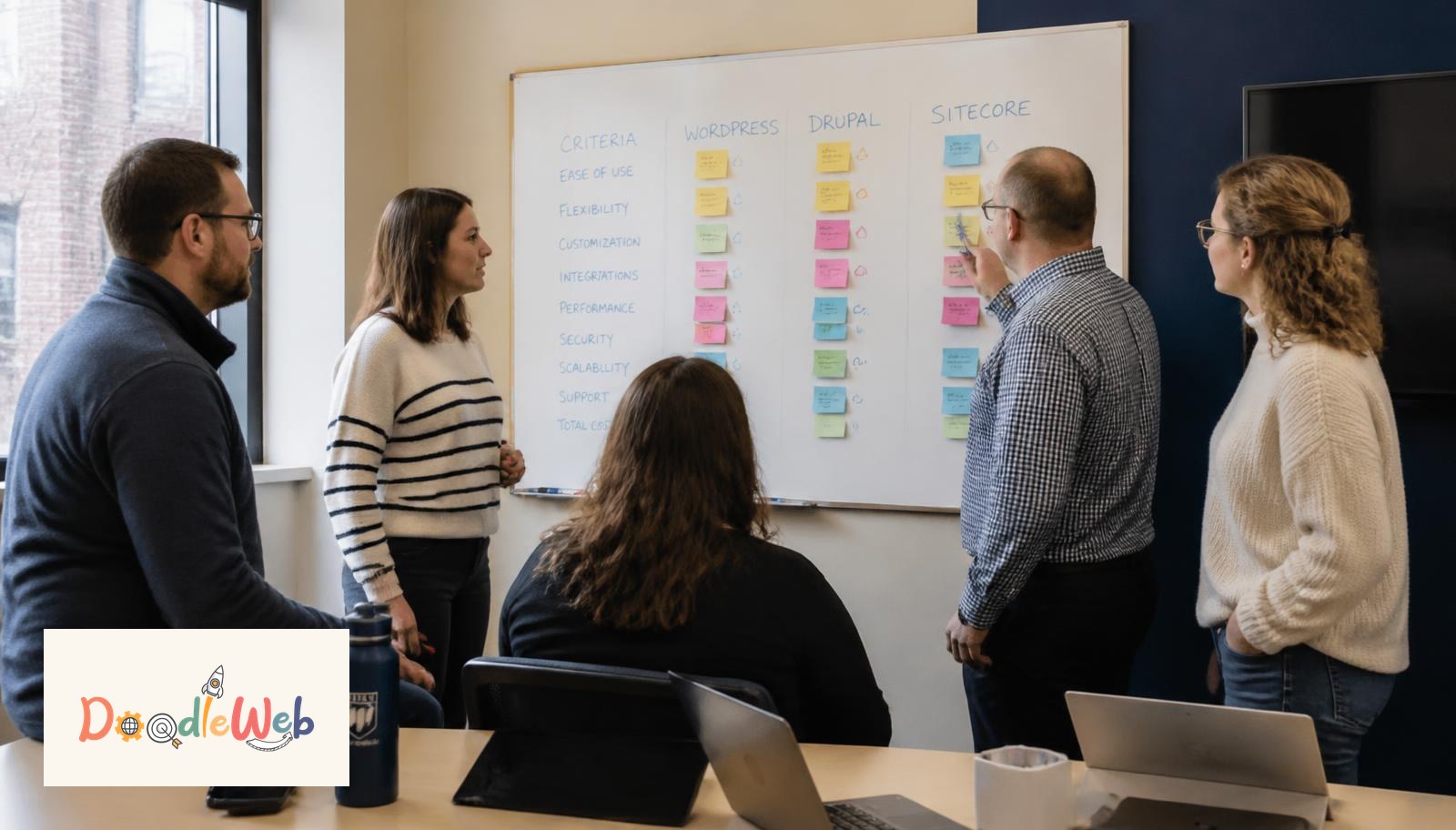

Choosing a website platform is the highest-leverage technical decision a growing college makes in a five-year cycle. The wrong platform locks in slow publishing, hostile accessibility remediation, and six-figure recurring license fees that eat the marketing budget. These are the seven platform decisions we walk every college through before we quote a rebuild.
1. Which CMS matches how your team actually publishes?
Drupal, WordPress, Webflow, and headless setups each fit a different editorial reality. Drupal fits colleges with 50+ editors and strict governance. WordPress fits colleges with 5 to 30 editors and a marketing-led workflow. Webflow fits smaller colleges under 3,000 FTE with a designer-led team. Match the platform to the humans, not the vendor pitch.
2. Is the hosting bill going to double when enrollment doubles?
WP Engine, Pantheon, and Acquia charge by traffic tier. A college jumping from 200k to 900k monthly sessions during application season can see hosting go from $18k to $56k a year overnight. Ask for the exact tier price at 2x, 4x, and 10x current traffic before signing.
3. Does the platform meet WCAG 2.2 AA out of the box?
The Department of Justice's April 2024 Title II rule requires most public colleges to be WCAG 2.2 AA conformant by April 2026 or April 2027 depending on enrollment size. Ask the vendor for a current VPAT. If they cannot produce one dated within twelve months, they are not a serious option.
4. Can content be translated and governed at the program level?
Programs launch, sunset, and rebrand every year. The platform must let a program owner update the program page without a ticket, without breaking the design system, and without touching the taxonomy. Test this with a real editor for fifteen minutes before you buy.
5. Does the platform expose structured data for AI search?
AI Overviews, ChatGPT, and Perplexity increasingly answer "which colleges offer a BSN in Ohio?" without sending a click. The platform must ship EducationalOccupationalProgram, Course, and FAQPage JSON-LD by default or through a maintained module. Hand-rolled schema decays inside eighteen months.
6. What is the true cost of an integration with your SIS and CRM?
Slate, Salesforce Education Cloud, and Banner integrations regularly add $40k to $120k to a first-year build. Get the integration scope, the exact endpoints, and a fixed price before signing. "We integrate with everything" from a vendor means "we have never done this integration."
7. Who owns the design system after launch?
If the theme is proprietary to the agency or vendor, every future change is a change order. Insist on an open-source theme or design tokens in a repository the college owns. This one clause is the difference between paying $8k for a small program-page redesign and paying $32k.
The shortlist that fits most growing colleges
For colleges under 5,000 FTE, WordPress on WP Engine with an Elementor or block-based theme is the fastest, cheapest, and best-supported option. For 5,000 to 20,000 FTE, Drupal on Pantheon or Acquia gives you the governance and translation depth the marketing team will need in year three. Above 20,000 FTE, evaluate headless (Contentful or Sanity front-ended with Next.js) only if you have an in-house dev team.
Read the companion pieces on choosing a college website platform, 9 website development factors for growing colleges, and 7 features colleges need, or book a free audit.
Seattle agency · Seattle, WA
A full-service digital agency working in WordPress, Drupal, Shopify, Webflow, React, and React Native. We partner with universities, nonprofits, governments, and growing brands to ship sites that hold up after launch.