Universities do not buy websites. They buy enrollment, accreditation cover, and a system their staff can run without calling an agency every Tuesday. The brief almost never says that out loud, which is why so many .edu redesigns land beautifully and then decay inside eighteen months. Here is what universities actually need from website development in 2026, based on the builds and rescues we run out of Seattle.
What do universities need most from a website in 2026?
Four things, in this order: program pages that answer a prospective student's question in the first paragraph, a governance model that keeps 40 departments from breaking the design system, WCAG 2.2 AA conformance that survives editor-created content, and page speed on a phone over a weak cellular connection. Everything else, including the homepage everyone argues about, is downstream of those four.
Why do university web projects fail after launch?
They fail because the build was scoped as a project and the site is a product. On launch day the design is coherent, the content is fresh, and the analytics are clean. Twelve months later 300 people have published 900 pages, half of them with images dropped in at full resolution and headings styled by hand. Nobody planned for that, so nobody owns it.
The fix is unglamorous: a component library editors cannot break, a review queue for new page types, and one named person per college who is responsible for their section. Institutions that appoint those owners keep their launch quality. Institutions that do not, do not.
What should a program page contain?
A program page is the highest-value page on a university site and usually the least considered. It needs, in order:
- A direct answer to what the program is, in one sentence a 17-year-old understands.
- Length, format, start terms, and delivery mode stated as facts, not prose.
- Cost, with a link to the real cost calculator rather than a PDF.
- Outcomes: what graduates do, with data the institutional research office will stand behind.
- Curriculum, faculty, and admission requirements.
- One request-for-information form with four fields.
EducationalOccupationalProgram and Course schema on that page is what lets Google and the answer engines quote it. Without structured data your program is a paragraph. With it, it is a record.
How does AI search change what universities need to build?
Students now ask ChatGPT, Gemini, and Perplexity to shortlist programs before they ever open a .edu. Those systems extract the first clean, attributable answer they can find. A page that opens with a welcome message from the dean gives them nothing to quote.
Practical consequence: write answer-first, keep facts in structured markup, publish a machine-readable summary of tuition and outcomes, and keep last-updated dates visible. We cover the full pattern in the AEO guide for higher education and in why a university goes invisible in AI search.
What is the accessibility requirement, precisely?
Under the 2024 Title II rule, most public institutions must meet WCAG 2.2 AA by April 2026 or April 2027 depending on size. The part that catches teams out is that conformance applies to content published after launch, not just the templates. That means editor training, an automated check in the publishing workflow, and a manual audit each semester. Our accessibility services page covers audits, remediation, and VPAT work.
Which CMS should a university choose?
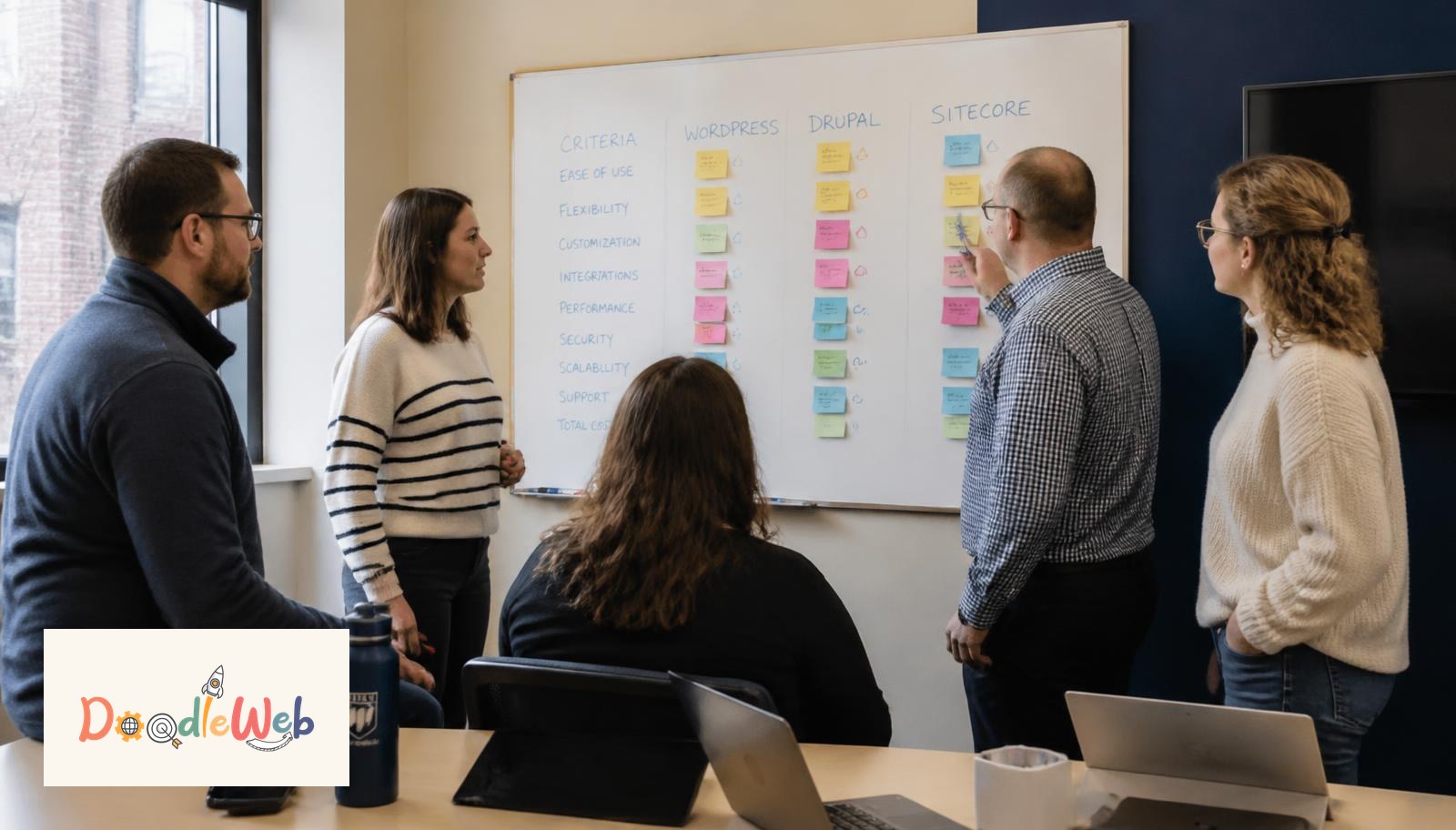
Drupal remains the default for institutions with many editors, complex permissions, and multilingual requirements. WordPress multisite fits institutions with lighter governance and a marketing-led web team. Headless is worth it only when a real product team exists to maintain the front end. We walk the trade-offs through in how to choose a college website platform, and DoodleWeb builds on both as a Drupal certified partner.
What does this cost and how long does it take?
A single-college marketing site with a real content model runs 12 to 20 weeks. A full institutional platform with departmental migration runs 6 to 12 months and is usually phased by college. The number that matters more than the build fee is the ongoing one: budget for a maintained product, not a finished project.
Where to go next
Read nine must-have elements of university website development, how to fix slow university websites, or what growing colleges should ask about website options. Or book a working session with our higher-ed team.
Seattle agency · Seattle, WA
A full-service digital agency working in WordPress, Drupal, Shopify, Webflow, React, and React Native. We partner with universities, nonprofits, governments, and growing brands to ship sites that hold up after launch.