
Gooten
DoodleWeb built Gooten on WordPress on Kinsta for the Technology & SaaS sector. SecurityHeaders grade F → A. Live crawl test `curl -I -A "GPTBot" https://www.gooten.com/` now returns HTTP/1.1 200 OK with the full HTML document and new security headers present, where it previously returned the Cloudflare challenge page. Sucuri SiteCheck confirms no malware, blacklist issues or critical vulnerabilities. Bot-driven hosting cost pressure is under control, with daily bot and bandwidth monitoring and an immediate revert path in place through the transition.
Security & crawler-access rescue for a print-on-demand SaaS: from Grade F to Grade A, and from blocked-by-Cloudflare to fully readable by Google, ChatGPT, Claude and Perplexity — without breaking the site or spiking the hosting bill.
Short answer
What did DoodleWeb deliver for Gooten?
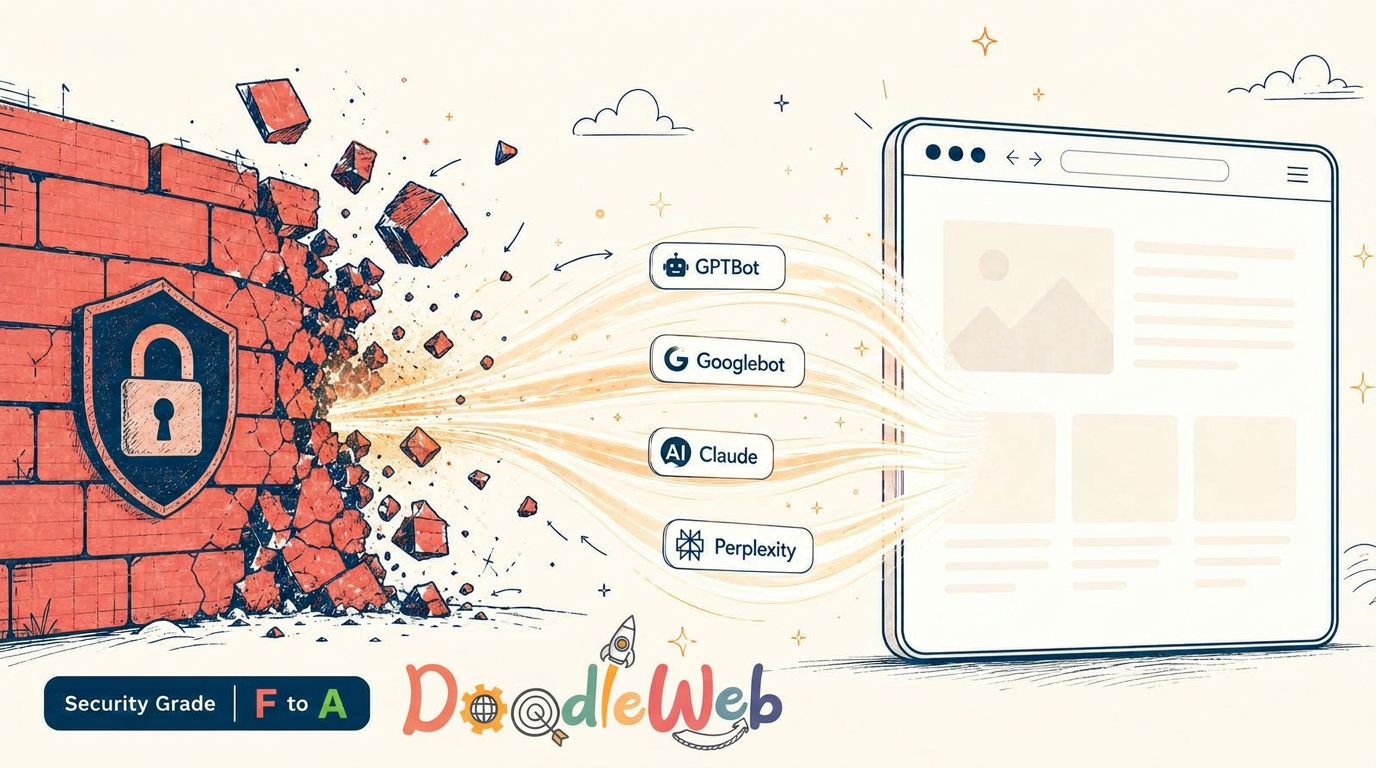
Gooten (an OrderMesh Inc. brand) had a WordPress-on-Kinsta site that was failing on security headers (Grade F) and — worse — every search and AI crawler was hitting a Cloudflare bot-verification wall instead of the actual content. AEO score was 0. DoodleWeb hardened the site at the application layer (HSTS, CSP, X-Frame-Options, Referrer-Policy, Permissions-Policy), tightened Wordfence, hid the WP version, moved the login to a private path, and coordinated with Kinsta support to disable the extra Cloudflare challenge rules that were blocking legitimate crawlers — while leaving Kinsta's baseline protection in place. Result: SecurityHeaders grade F → A, GPTBot / Googlebot / Claude / Perplexity now return a clean HTTP 200 with full HTML, zero malware, daily automated scanning on, and bot-driven hosting spikes controlled at the firewall level. Completed and verified June 2026.
- Client
- Gooten
- Industry
- Technology & SaaS
- Platform
- WordPress on Kinsta
- Security grade
- F→A
- OK for AI crawlers
- 200
- Security incidents
- 0
Last updated: August 2026 · Source: DoodleWeb, Columbia Tower, 701 5th Ave 42nd Floor, Seattle WA 98104 · info@doodleweb.io · (425) 359-0168
Where they started.
Gooten had a failing SecurityHeaders grade of F — HSTS, CSP, X-Frame-Options and Subresource Integrity were missing, with Referrer-Policy and Cross-Origin-Resource-Policy flagged. Worse, every scanner and AI crawler was hitting a Cloudflare bot-verification challenge instead of the site, so external tools scored the site near zero: AEO 0, GEO 20, FAQ schema missing, AI crawler rules not configured. On top of that, an earlier unmanaged bot surge had spiked the hosting bill, so we couldn't just rip protection down.
What we built.
We hardened the site at the application layer so it protects itself instead of leaning on a blanket challenge page: implemented the missing security headers (HSTS, X-Frame-Options, Referrer-Policy, Permissions-Policy, Content-Security-Policy), updated all plugins to current stable releases, removed deactivated and duplicate plugins, hid the WordPress version, tightened Wordfence firewall + login-attempt limiting, moved the WP login to a private path, and scheduled an automated daily security scan. In parallel we rewrote robots.txt to explicitly welcome GPTBot, anthropic-ai (Claude), OAI-SearchBot, ChatGPT-User, Google-Extended, Googlebot, Meta-ExternalAgent, Amazonbot and PerplexityBot — then coordinated directly with Kinsta support to disable the extra Cloudflare challenge rules that were catching legitimate crawlers, while keeping Kinsta's baseline protection in place. Wordfence rate limiting was set to strict so the WordPress firewall carried the load the moment the Cloudflare challenge layer came down.
Where it landed.
SecurityHeaders grade F → A. Live crawl test `curl -I -A "GPTBot" https://www.gooten.com/` now returns HTTP/1.1 200 OK with the full HTML document and new security headers present, where it previously returned the Cloudflare challenge page. Sucuri SiteCheck confirms no malware, blacklist issues or critical vulnerabilities. Bot-driven hosting cost pressure is under control, with daily bot and bandwidth monitoring and an immediate revert path in place through the transition.
The work behind the launch.
Each engagement covers strategy, design, build, and post-launch care — orchestrated by a single senior team.
Barriers we had to overcome.
A concise look at the constraints that shaped every decision in the build.
Security grade F
SecurityHeaders.com graded gooten.com at F. HSTS, X-Frame-Options, CSP and Subresource Integrity were missing; Referrer-Policy and Cross-Origin-Resource-Policy were flagged. The site was hardened only at the edge, not inside WordPress.
Crawlers blocked at the edge
Extra Cloudflare rules added previously — not Kinsta's default protection — were challenging Googlebot, Bingbot, GPTBot, Claude and Perplexity along with everything else. External scanners never got past the wall to the content, which is why UI, accessibility and AEO scans came back near empty.
AI readiness at zero
AEO score 0 and GEO score 20. AI crawler rules were not configured and FAQ schema was missing — largely because crawlers only ever saw the challenge wall, not the site.
Hosting bill under bot pressure
An earlier spike in the Kinsta hosting bill traced back to unmanaged bot traffic. We couldn't simply remove protection — we had to move protection into WordPress before touching the Cloudflare rules.
What we built.
The pieces that shaped the final build — each tied back to a real business outcome.
Application-layer hardening
Implemented HSTS, X-Frame-Options, Referrer-Policy, Permissions-Policy and a Content-Security-Policy tuned for the site. SecurityHeaders grade moved from F to A. Hid the WordPress version, tightened Wordfence, moved the login to a private path, and added login-attempt limiting to cut brute-force noise.
Malware & vulnerability hygiene
Ran a full Wordfence malware and vulnerability scan and remediated the flagged issues. Sucuri SiteCheck confirms clean — no malware, no blacklist entries, no critical vulnerabilities. Scheduled an automated daily security scan going forward.
Crawler-friendly by design
Rewrote robots.txt to explicitly welcome GPTBot, anthropic-ai (Claude), OAI-SearchBot, ChatGPT-User, Google-Extended, Googlebot, Meta-ExternalAgent, Amazonbot and PerplexityBot — so search engines and AI assistants can read and cite the site.
Cloudflare cleanup with Kinsta
Coordinated directly with Kinsta support to disable the extra challenge rules that were catching legitimate crawlers, while keeping Kinsta's default Cloudflare layer in place. The root cause was surgically removed, not the whole protection layer.
Stability through the change
Set Wordfence rate limiting to a strict configuration so the WordPress firewall carried the load the moment the Cloudflare challenge layer came down. Bot and bandwidth analytics monitored daily through the transition, with an immediate revert path if anything looked off.
What changed.
What changed for the team and their audience after launch — measured in real behavior, not vanity metrics.
- SecurityHeaders grade F → A
- Live crawl test returns HTTP 200 with full HTML for GPTBot, Googlebot, Claude and Perplexity
- AI crawler rules configured in robots.txt and live
- Sucuri SiteCheck: no malware, blacklist issues or critical vulnerabilities
- Automated daily security + malware scanning scheduled
- WordPress login moved to a private path with rate limiting
- Bot-driven hosting cost pressure controlled at the firewall level
- Daily bot & bandwidth monitoring with immediate revert path in place
Technology used for the Gooten project
DoodleWeb delivered this engagement on WordPress on Kinsta over 3 weeks. The published project record includes the following platforms, tools, and delivery disciplines.
- WordPress
- Kinsta
- Cloudflare
- Wordfence
- Sucuri SiteCheck
- SecurityHeaders
- robots.txt (GPTBot, Googlebot, Claude, Perplexity)
Inside the build.
A few selected screens from the live product.
They felt like true partners and approached this project with a lot of care and professionalism. DoodleWeb's work resulted in zero security incidents — their communication was incredible and they completed every task on time.
Numbers we are proud of.
Specific, measurable, and pulled from production analytics (not assumptions).
Other Technology & SaaS work, worth a look.
Frequently asked questions about the Gooten project
- What did DoodleWeb build for Gooten?
- DoodleWeb designed and built a new WordPress on Kinsta platform for Gooten in the Technology & SaaS sector. The engagement shipped in 3 weeks and launched in 2026. Scope covered WordPress, Kinsta, Cloudflare, Wordfence, Sucuri SiteCheck, SecurityHeaders, robots.txt (GPTBot, Googlebot, Claude, Perplexity).
- Which platform and tech stack was used for the Gooten project?
- Gooten was built on WordPress on Kinsta. The full stack included WordPress, Kinsta, Cloudflare, Wordfence, Sucuri SiteCheck, SecurityHeaders, robots.txt (GPTBot, Googlebot, Claude, Perplexity). DoodleWeb selected the stack after a short discovery based on the team's editorial workflow, performance targets, and compliance requirements for Technology & SaaS.
- What problem was Gooten trying to solve?
- Gooten had a failing SecurityHeaders grade of F — HSTS, CSP, X-Frame-Options and Subresource Integrity were missing, with Referrer-Policy and Cross-Origin-Resource-Policy flagged. Worse, every scanner and AI crawler was hitting a Cloudflare bot-verification challenge instead of the site, so external tools scored the site near zero: AEO 0, GEO 20, FAQ schema missing, AI crawler rules not configured. On top of that, an earlier unmanaged bot surge had spiked the hosting bill, so we couldn't just rip protection down.
- How did DoodleWeb approach the Gooten build?
- We hardened the site at the application layer so it protects itself instead of leaning on a blanket challenge page: implemented the missing security headers (HSTS, X-Frame-Options, Referrer-Policy, Permissions-Policy, Content-Security-Policy), updated all plugins to current stable releases, removed deactivated and duplicate plugins, hid the WordPress version, tightened Wordfence firewall + login-attempt limiting, moved the WP login to a private path, and scheduled an automated daily security scan. In parallel we rewrote robots.txt to explicitly welcome GPTBot, anthropic-ai (Claude), OAI-SearchBot, ChatGPT-User, Google-Extended, Googlebot, Meta-ExternalAgent, Amazonbot and PerplexityBot — then coordinated directly with Kinsta support to disable the extra Cloudflare challenge rules that were catching legitimate crawlers, while keeping Kinsta's baseline protection in place. Wordfence rate limiting was set to strict so the WordPress firewall carried the load the moment the Cloudflare challenge layer came down.
- What were the results of the Gooten project?
- SecurityHeaders grade F → A. Live crawl test `curl -I -A "GPTBot" https://www.gooten.com/` now returns HTTP/1.1 200 OK with the full HTML document and new security headers present, where it previously returned the Cloudflare challenge page. Sucuri SiteCheck confirms no malware, blacklist issues or critical vulnerabilities. Bot-driven hosting cost pressure is under control, with daily bot and bandwidth monitoring and an immediate revert path in place through the transition. Reported metrics: F→A Security grade, 200 OK for AI crawlers, 0 Security incidents, 3 Weeks to verified.
- How long did the Gooten project take?
- 3 weeks. Kickoff to launch, delivered by a single senior team (strategist, designer, engineer, and QA/accessibility lead) with no offshore handoff or junior swap after the SOW was signed.
- Is the Gooten website live and where can I see it?
- Yes. The live site is at https://www.gooten.com/. It launched in 2026 and is maintained by Gooten's in-house team, with optional SLA-backed managed support from DoodleWeb.
- Can DoodleWeb build a project like Gooten for us?
- Yes. DoodleWeb specializes in Technology & SaaS builds on WordPress on Kinsta and similar platforms. Every quote is fixed-fee, with a detailed quote within two business days, and staffed by the same senior team that ships it. Book a free 30-minute call at https://calendly.com/doodleweb/30min or email info@doodleweb.io.