Choosing a college website platform in 2026 is not a CMS decision. It is a governance, accessibility, and AI-visibility decision that happens to have a CMS at the bottom of it. The right platform is the one your editors will actually use, your accreditor will accept, and Google's AI Overviews will read cleanly. Here is the working framework we use with higher-ed clients.
What are the real options in 2026?
Four platforms account for the overwhelming majority of new higher-ed builds:
- Drupal 11: the default for research universities, community college systems, and any institution with strict WCAG, Title II, or FERPA obligations.
- WordPress VIP or enterprise WordPress: strong for undergraduate-focused colleges, alumni sites, and marketing-led rebuilds.
- Webflow Enterprise: increasingly viable for smaller private colleges with a small marketing team and no in-house dev.
- Custom on a headless CMS (Sanity, Contentful, Payload): for institutions that need one editorial layer feeding a website, a mobile app, a portal, and digital signage.
Everything else (Sitecore, Adobe Experience Manager, Cascade) is a legacy conversation. If you already run one and it works, keep it. If you are choosing fresh in 2026, the four above are where honest evaluations begin.
How do we compare them?
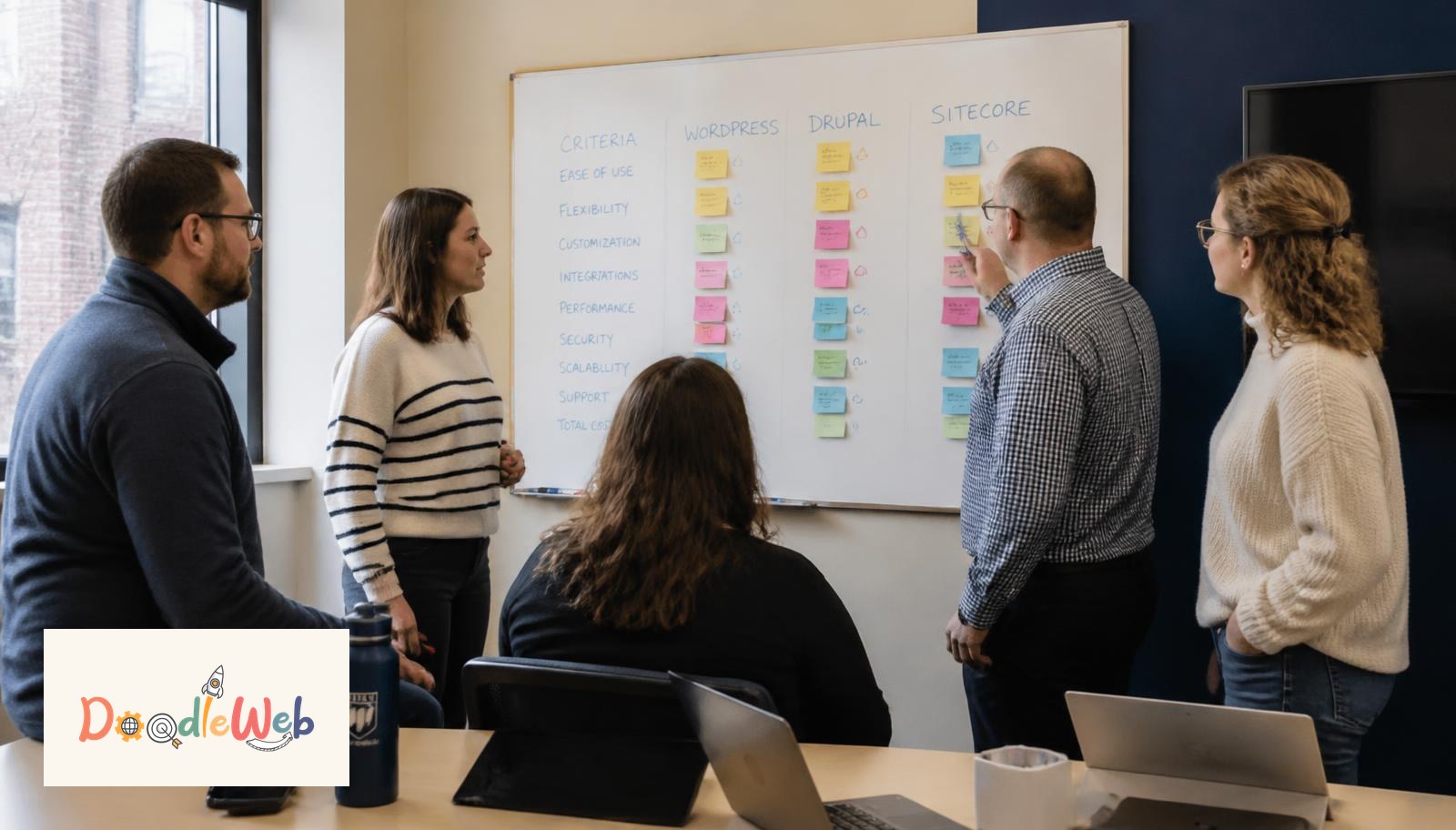
Score each platform against the seven criteria that actually matter:
- Editor experience. Can a program coordinator publish an event without a ticket?
- Accessibility posture. Does the platform ship WCAG 2.2 AA components or leave it to your team?
- Structured data support. How easy is it to emit Course, Program, Person, and Event JSON-LD?
- Governance. Can you enforce a review workflow, permissions per college, and a brand system across 40 sub-sites?
- Total cost of ownership over five years, including hosting, licenses, and specialist labor.
- Migration cost from what you have today.
- Talent availability in your region and budget band.
Which platform is right for us?
The honest answer depends on three questions.
How many editors publish per week? Under five: WordPress or Webflow. Five to fifty: WordPress or Drupal. Over fifty: Drupal or headless.
How many sub-sites do you run? One or two: any of the four. Five to twenty: WordPress multisite or Drupal. Over twenty: Drupal or headless with a design system.
How central is research or grant funding to your identity? Very central: Drupal, almost always. Not very: any of the four.
Does the CMS decision affect AI visibility?
Yes, but less than the content decision does. All four platforms can emit clean structured data, fast Core Web Vitals, and Q&A page structures. The AI engines do not care what CMS you run. They care whether your program pages open with a direct answer, whether your data is structured, and whether your facts match across the web. A great platform poorly used loses to a modest platform used well. We covered this in depth in the AEO guide for higher education.
How much should we budget?
Realistic 2026 ranges for a full rebuild by a senior team:
- WordPress or Webflow: $80k to $220k.
- Drupal: $180k to $600k.
- Headless: $250k to $900k.
Anything under $60k for a real higher-ed rebuild is a red flag: it is either an overseas resell or a template swap that will not survive an accessibility audit.
What is the biggest platform mistake colleges make?
Choosing the platform before choosing the governance model. If your marketing office cannot enforce a review process today, no platform will fix that. If your 12 schools each want their own homepage tone, no platform will unify that. Get alignment on how the site will be governed first, then choose the platform that supports that governance.
Where to go next
Once you know the platform, the harder work begins: the nine web development factors that actually move enrollment, the seven features colleges need, and a plan for fixing the slow university site you already run. Or book a platform advisory session with our higher-ed team.
Seattle agency · Seattle, WA
A full-service digital agency working in WordPress, Drupal, Shopify, Webflow, React, and React Native. We partner with universities, nonprofits, governments, and growing brands to ship sites that hold up after launch.