Tell us about your campus website
A senior engineer reads every message and replies within one working day.
University websites serve several distinct audiences at the same time. Prospective students, current students, faculty and staff, parents, and alumni and donors all arrive with different questions and different reasons for being there. Most higher education websites underperform because they are built as one general purpose site rather than around those audiences and the tasks each one needs to complete.
University website development is also different from ordinary marketing site work. These projects involve legal accessibility requirements, dozens of departments publishing independently, integrations with student information and admissions systems, and content that has to hold up under heavy seasonal traffic. This article covers the nine elements that matter most in a university website development project, and how to sequence them.
Key takeaways
Set accessibility acceptance criteria early, and confirm the institution’s applicable legal requirements and deadlines with qualified advice.
Navigation should be organized around audiences and tasks rather than around the institution's internal structure.
Program and degree pages are the highest value pages on a university website and should each be individually indexable.
Site performance affects the mobile application experience; use institutional analytics rather than assuming that mobile applicants are a majority.
Structured data and clearly written answers can help systems interpret university information; appearance in AI search results is not guaranteed.
1. Accessibility compliance built in from the start
Plan accessibility from discovery through ongoing publishing rather than leaving it to a launch checklist. Confirm the institution’s applicable legal duties, current deadlines, exceptions, and contract requirements with qualified advice. This article does not establish a legal compliance deadline for your campus.
WCAG 2.2 defines Level AA conformance through the applicable Level A and AA success criteria. Shared components can support consistent labels, contrast, focus behavior, and heading structure, but editors and third-party integrations can still introduce barriers. A template or an automated scan is not a guarantee of conformance.
Test course tables, captions and transcripts, documents, keyboard-operated interactions, and third-party application and giving tools. Use representative tasks with keyboard and assistive technology, and record the barriers and resolution responsibilities.
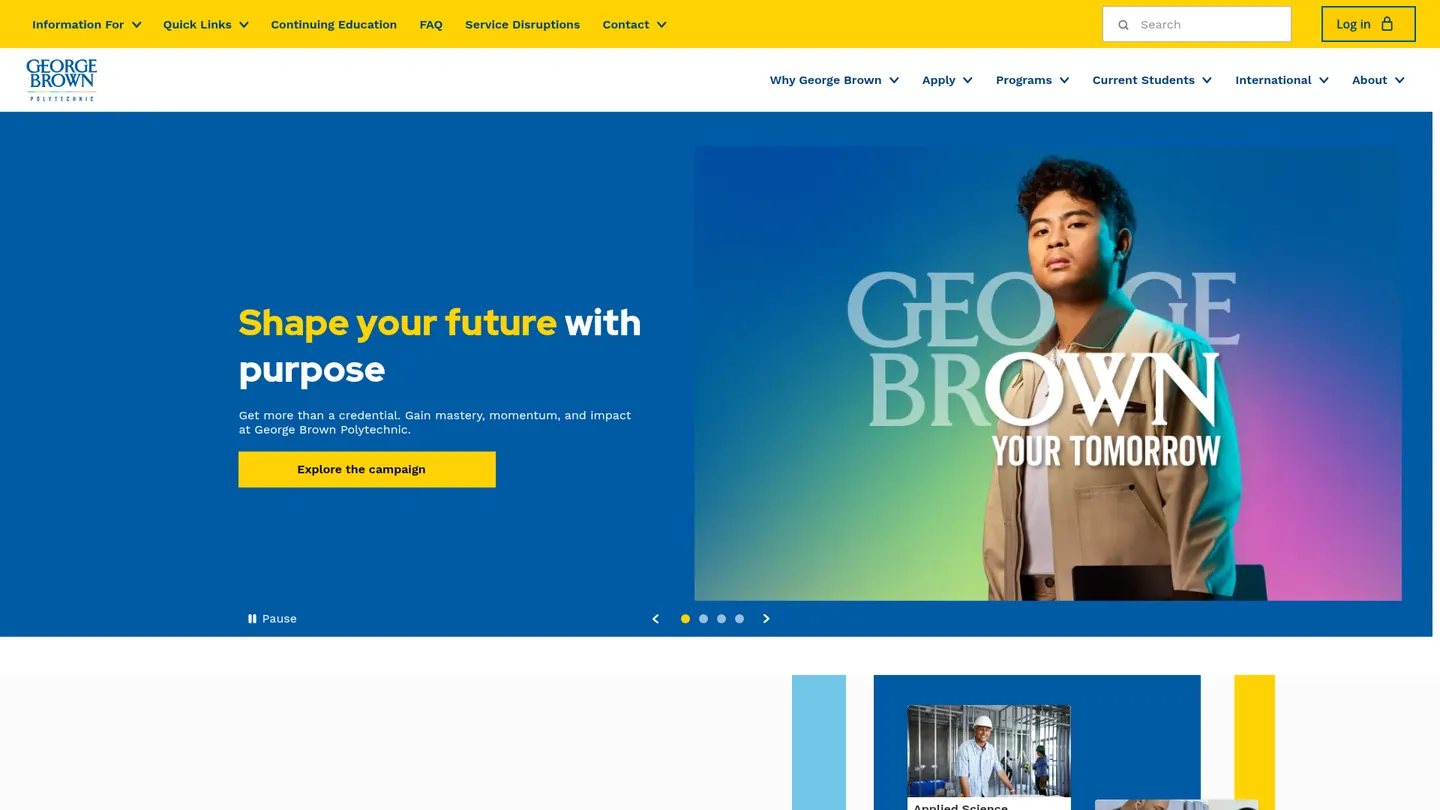
Our George Brown College case study describes a Drupal accessibility audit, remediation, and editor training. Use that published scope as an example of an engagement, not a prediction of your campus results. Include regression checks, content training, and an owner for future findings in the handover plan.
2. Information architecture organized by audience
Navigation should be organized around what visitors are trying to do, not around how the institution is organized internally. Most university sites are structured to mirror the org chart, which means visitors have to understand the institution before they can find anything.
The audiences on a university site want different things and rarely overlap. Prospective students want programs, cost, admission requirements, and deadlines. Current students want registration, financial aid status, academic calendars, and campus services. Faculty and staff want internal tools and administrative procedures. Parents want cost, safety, outcomes, and support services. Alumni and donors want impact, events, and a way to give.
Serving all of these from a single general homepage forces every visitor to filter through content meant for someone else. The alternative is to map each audience to its own entry point, its own message, and its own next step. A prospective student path leads to programs and application. A current student path leads to a portal login and student services. A donor path leads to impact reporting and giving. The brand stays consistent while the experience differs by who is using it.
This also reduces the pressure on the homepage. When each audience has a clear route, the homepage no longer needs to carry every message at once. It can introduce the institution and route people quickly.
Two structural decisions usually matter most in higher education web design. The first is separating public marketing content from authenticated internal content, so current students are not competing with prospective students for the same navigation space. The second is deciding where academic department sites live, and whether they follow the central design system or run independently. Departments that operate outside the system are where accessibility and brand consistency break down first.
3. A program and degree finder that works
Program pages are the highest value pages on a university website. They are where prospective students form their decision, and they are the pages most likely to be found through search or recommended by an AI assistant. Each program should exist as its own indexable page with a stable URL, not as an entry inside a PDF catalog or a filtered view that cannot be linked to directly.
A program finder should let visitors filter by the criteria they actually use. Degree level, whether the program is offered online, hybrid, or on campus, academic area or department, start term, and full time or part time status. Filters should update the URL so that a filtered result can be shared and indexed.
Each program page should answer the questions a prospective student has before they ask an admissions counselor. What the degree is and what it prepares graduates to do. Length and credit requirements. Format and delivery. Admission requirements and deadlines. Tuition and fee information or a direct link to it. Career outcomes and typical employers. Faculty who teach in the program. A clear next step, whether that is requesting information, scheduling a visit, or applying.
Consistency across program pages matters more than depth on any single one. When every program page follows the same structure, the content becomes far easier to maintain, easier to compare, and significantly easier for search engines and AI systems to interpret. Adding Course and EducationalOccupationalProgram structured data to these pages makes the information machine readable, which is increasingly what determines whether a program appears in an AI generated recommendation.
4. Site performance and Core Web Vitals
Site speed affects whether prospective students complete the actions a university website exists to support. Slow pages increase abandonment on application forms, inquiry forms, and program searches, and performance is a confirmed ranking signal in Google search.
Google measures three metrics. Largest Contentful Paint measures how long the main content takes to appear, and should be under 2.5 seconds. Interaction to Next Paint measures responsiveness when someone taps or clicks, and should be under 200 milliseconds. Cumulative Layout Shift measures unexpected movement of page elements while loading, and should stay below 0.1.
Higher education sites fail these measures for consistent reasons. Large uncompressed campus photography and video backgrounds on homepages and program pages. Accumulated third party scripts from chat tools, analytics platforms, marketing automation, accessibility overlays, and advertising pixels, often added over years without anyone removing the ones no longer in use. Legacy templates carrying unused CSS and JavaScript. Embedded maps, calendars, and social feeds that load before the main content. Fonts that block rendering.
The fixes are usually straightforward once the causes are identified. Serve images in modern formats at appropriate sizes with lazy loading below the fold. Audit third party scripts and remove what is no longer used, then defer what remains. Reserve space for embedded elements so the layout does not shift as they load. Preload critical fonts and use a font display strategy that renders text immediately.
Performance also has to be maintained. A site that passes at launch will degrade as departments add content and marketing teams add tools, so performance budgets and periodic reviews should be part of the ongoing governance plan.
5. A content management system with real governance
Universities publish content across dozens of departments, and the content management system has to make that safe. The problem is rarely the platform itself. It is what happens when hundreds of editors with varying skill levels publish into it without structure.
Governance in this context means several things working together. Role based permissions so editors can only modify content they are responsible for. Editorial workflows with review and approval steps for content that carries legal, financial, or accreditation implications. A component library that lets editors assemble pages from pre approved blocks rather than writing free form markup. Locked global elements such as headers, footers, and navigation so a single department cannot alter site wide structure. Content types with defined fields, so a program page always contains the same information in the same place.
The component approach is what protects accessibility and brand consistency over time. When an editor can only build a page from tested components, the resulting page inherits correct heading structure, contrast, and responsive behavior automatically. When editors can paste in arbitrary code or unstructured content, quality depends on the individual, and at university scale that is not sustainable.
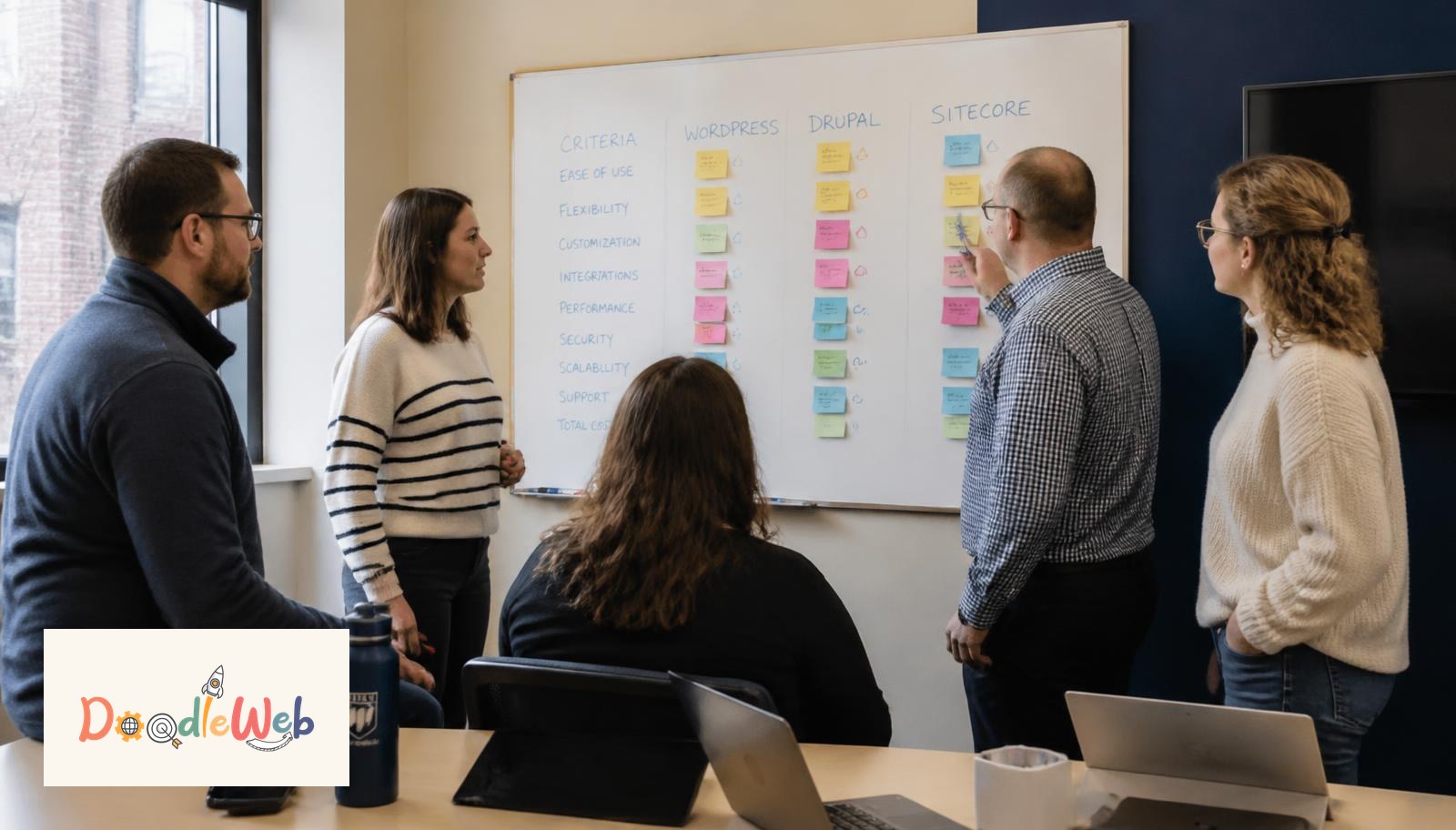
Platform selection follows from these needs. Drupal is the common choice for large institutions because it handles complex content modeling, granular permissions, and multi site architectures where individual departments run their own sites under shared governance. WordPress works well for smaller institutions, individual schools within a university, or campaign and microsite work where the content model is simpler. The right answer depends on the number of editors, the number of sites, and the complexity of the content relationships rather than on platform preference.
Migration planning deserves attention as part of this. Many university sites still run on unsupported platform versions, and moving to a current version is often the point at which content structure and governance can be corrected.
6. Integrations with campus systems
A university website that does not connect to campus systems creates manual work and loses inquiries. Every form submission that lands in an inbox rather than a system of record is a lead that depends on someone remembering to transfer it.
The integrations that matter most in higher education are the admissions CRM, the student information system, the learning management system, the events platform, and the donation platform. Inquiry forms and application starts should pass directly into the CRM, which for many institutions is Slate or Salesforce Education Cloud. Program, course, and academic calendar data often originates in the student information system, commonly Banner, Colleague, or Workday Student, and should feed the website rather than being maintained separately by hand. Event listings should come from a single source so that departmental calendars and the main calendar do not diverge. Giving forms should connect to the advancement platform so that donation data reaches the right teams without reconciliation.
The principle behind these integrations is that data should have one authoritative source. When program information is maintained in the catalog system, the website, and a departmental page independently, the three will disagree within a term. Pulling from a single source keeps the site accurate and removes recurring maintenance work.
Single sign on is the other integration worth planning early. Students, faculty, and staff should move between the public site and authenticated systems without re entering credentials, and identity should be handled through the institution's existing provider rather than through a separate website login.
These connections should be defined during discovery rather than added afterward. Integration requirements affect content modeling, hosting, and security decisions, and retrofitting them into a completed build is consistently more expensive than planning for them.
7. Mobile first design for how students browse
Most prospective student traffic to university websites comes from mobile devices, and for younger visitors the share is higher still. A site designed on desktop and adjusted for mobile afterward will underperform with the audience that matters most to enrollment.
Designing mobile first changes several decisions. Navigation has to work without hover, which means megamenus need a tap based equivalent that does not bury important destinations. Tap targets need enough size and spacing to be used reliably. Body text needs to be readable without zooming. Tables of course requirements and tuition costs need a responsive treatment rather than horizontal scrolling. Campus imagery needs to be cropped and served at sizes appropriate to small screens rather than scaled down from desktop assets.
Forms deserve particular attention because they are where mobile visitors abandon. Inquiry and application forms should ask for the minimum information needed at that stage, use appropriate input types so mobile keyboards match the field, save progress on longer forms, and avoid file upload requirements at early stages when a prospective student is likely on a phone.
Virtual tours, campus maps, and video content should be tested on mobile networks rather than campus wifi. These are the elements most likely to work well in testing and fail for an actual applicant on a phone with limited connectivity.
Mobile performance and mobile accessibility are related to this. Touch targets, contrast in outdoor lighting, and orientation support are accessibility requirements as well as usability ones, so the same work supports both goals.
8. Security, hosting, and maintenance
University websites hold and transmit information that carries regulatory obligations, and they have to stay available during periods when downtime is most costly. Application deadlines, registration windows, orientation, and giving days all concentrate traffic into narrow periods, and an outage during one of them has direct consequences.
Hosting should be sized for those peaks rather than for average traffic, with caching and a content delivery network in place so that traffic surges do not reach the origin server directly. Staging and development environments should mirror production so that changes can be tested before release.
Security requirements include HTTPS across the entire site, regular patching of the platform core and all modules or plugins, hardened administrative access with multi factor authentication, and monitoring for unauthorized changes. Any form that collects personal information from applicants or students should be reviewed for FERPA implications, and student record data should stay in the systems designed to hold it rather than being duplicated into website databases.
Unmaintained plugins and modules are the most common point of failure on higher education sites. Vulnerabilities are disclosed constantly, and automated scanning finds unpatched sites quickly. A site that is updated only when something breaks will eventually be compromised. Ongoing maintenance covering core and extension updates, security patching, uptime monitoring, backups, and periodic restore testing is not an optional add on to a university website development project. It is what keeps the investment intact.
Backups should be tested rather than assumed. A backup that has never been restored is an untested assumption, and the time to discover a problem with it is not during an incident.
9. Structured data and AI search visibility
Prospective students increasingly ask AI assistants for program recommendations and comparisons, and those systems answer by citing sources they can read and interpret. Appearing in those answers requires content that is crawlable, factually clear, and marked up in a machine readable way.
Structured data is the foundation. University sites should implement Organization or CollegeOrUniversity schema for the institution, Course and EducationalOccupationalProgram schema for academic offerings, Event schema for campus events and information sessions, and FAQPage schema for common admissions and financial aid questions. This markup tells search and AI systems what each piece of content represents rather than leaving them to infer it from layout.
Content structure matters as much as markup. AI systems tend to cite passages that answer a question directly and completely in a short span of text. That means each section of a page should open with a direct answer before elaborating, facts such as tuition, deadlines, and credit requirements should appear as text rather than inside images or PDFs, and important information should not be locked behind interactive elements that a crawler cannot open.
Technical access is the third requirement. Program and course information hidden behind JavaScript that only loads on interaction, or published only as downloadable PDFs, is effectively invisible to these systems. Crawlers also need to be allowed. Bot protection configured too aggressively will block AI crawlers along with malicious traffic, which removes the institution from consideration entirely.
This work is generally described as answer engine optimization or generative engine optimization. It does not replace traditional search work. It extends it, because the same qualities that make content citable by an AI system also make it easier for search engines and human visitors to use.
How to prioritize these elements
Universities rarely have the budget or timeline to address all nine at once. A workable sequence follows.
Address accessibility and performance first. These carry legal exposure and affect every page on the site, and they are difficult to retrofit once new content and features are layered on top.
Restructure navigation and program pages second. This is where enrollment outcomes are most directly affected, and it establishes the content model that everything else depends on.
Add integrations, governance workflows, and AI search visibility third. These build on a corrected foundation and deliver compounding returns over time.
Attempting the third group before the first two produces integrations feeding an inaccessible site and structured data describing content that visitors cannot find.
Frequently asked questions
/What is the best website development service for colleges and universities?
The best fit is an agency with direct higher education experience, demonstrated accessibility expertise covering WCAG 2.1 and 2.2 Level AA and ADA Title II, enterprise content management system capability in Drupal or WordPress, and experience integrating with admissions and student information systems. Ask for higher education references and an accessibility conformance report from recent work. DoodleWeb provides university website development services for institutions across the United States.
/Which website development service helps universities improve student engagement?
Student engagement improves when a website is organized around audience tasks rather than institutional structure, loads quickly on mobile devices, and connects to the systems students already use. Look for a partner experienced in audience based information architecture, program finder development, and CRM and student information system integration. DoodleWeb builds these systems for colleges and universities with accessibility and performance included from the start.
/How much does university website development cost?
Cost depends on templates, content volume, migration, integrations, accessibility testing, and review responsibilities. Ask for an itemized proposal that identifies exclusions and dependencies. Review DoodleWeb pricing, then confirm hosting, ongoing care, remediation, and training separately where appropriate; no universal institutional price range is substantiated here.
/How long does a university website redesign take?
The delivery plan depends on content readiness, migration volume, integrations, procurement, and campus approvals. Agree on discovery, design, implementation, migration, testing, and launch gates in writing. Identify content owners early and include review time in each phase; the published case studies are examples, not standard campus delivery promises.
/What content management system is best for a university website?
Drupal is an option to evaluate for institutions because it supports complex content modeling, granular editorial permissions, and multi site architectures for departments operating under shared governance. WordPress fits smaller institutions, individual schools, and campaign sites well. The right choice depends on the number of editors, the number of sites, and the complexity of content relationships rather than on platform preference.
Working with DoodleWeb on university website development
DoodleWeb is a Seattle based digital agency that builds websites for higher education, government, and enterprise organizations. Our higher education work covers accessible enterprise content management system builds, Drupal migrations from unsupported versions, audience based information architecture, program finder development, and integrations with admissions and student systems.
Agree on the accessibility scope, testing method, acceptance criteria, and ongoing publishing responsibilities for your engagement. Shared component libraries can help maintain consistency but do not guarantee that future content remains accessible or legally compliant. We are a Drupal Certified partner and an Acquia partner, and we work with institutions across the United States on both new builds and remediation of existing sites.
If you are planning a university website project or working through an accessibility deadline, we can review your current site and outline what the work would involve. Read the companion pieces on college website development in 2026, 7 website platform decisions for growing colleges, and why university websites get slow, or book a free audit.
Relevant client work


Berklee College of Music is a DoodleWeb client. Client recognition alone is not evidence of a particular project outcome.
George Brown College: accessibility work
Our published case study describes accessibility audit and remediation work on a Drupal platform, alongside editor training. Review the documented scope rather than assuming the same result for another campus.
Read the case study →Use one real degree page as the acceptance test for the whole system.
- Have admissions verify entry requirements, fees, deadlines, and the next step.
- Test program search and inquiry forms with a keyboard and on a phone.
- Ask a department editor to revise a program page and send it through approval.
Sources and fact-check report
Reviewed 2026-10-05. Site sources substantiate published project scope and client recognition, not independently audited outcomes. Recommendations are editorial guidance, not revenue, ranking, compliance, price, or delivery guarantees.
- DoodleWeb Brand Book / brand guidelines
- DoodleWeb published identity and client recognition
- Published project scope: George Brown College
- W3C WCAG 2.2: Level AA conformance criteria
- Google web.dev: Core Web Vitals definitions and thresholds
- Reviewed claim: Private institutions receiving federal funding face parallel obligations under Section 504 and Section 508.
Resolution:Applicable obligations vary by institution and jurisdiction; federal funding alone should not be treated as proof that Section 508 applies. Confirm requirements with qualified legal advice.
- Reviewed claim: Compliance dates are tied to population size, with the deadline for larger public entities in April 2026 and April 2027 for smaller ones.
Resolution:Check the current Department of Justice guidance for the applicable entity, compliance date, scope, and exceptions rather than relying on a date summarized here.
- Reviewed claim: Site performance directly affects mobile applicants, who make up the majority of prospective student traffic.
Resolution:Site performance affects the mobile application experience; use institutional analytics rather than assuming that mobile applicants are a majority.
- Reviewed claim: Structured data and clearly written answers determine whether a university appears in AI search results.
Resolution:Structured data and clearly written answers can help systems interpret university information; appearance in AI search results is not guaranteed.
- Reviewed claim: Public universities are subject to the ADA Title II web accessibility rule, which requires conformance with WCAG 2.1 Level AA.
Resolution:Set accessibility acceptance criteria early, and confirm the institution’s applicable legal requirements and deadlines with qualified advice.
- Reviewed claim: Accessibility is a legal requirement for university websites, not an optional improvement. Public colleges and universities are covered by Title II of the Americans with Disabilities Act. The Department of Justice final rule published in 2024 requires web content and mobile applications to conform with WCAG 2.1 Level AA. Check the current Department of Justice guidance for the applicable entity, compliance date, scope, and exceptions rather than relying on a date summarized here. Applicable obligations vary by institution and jurisdiction; federal funding alone should not be treated as proof that Section 508 applies. Confirm requirements with qualified legal advice.
The practical difference is between building accessible and remediating later. Remediation is more expensive, and it tends to repeat every time a department publishes new content. Building accessibility into the design system means the components themselves enforce it. Color contrast ratios are set in the theme. Form fields carry labels by default. Headings follow a proper hierarchy because the templates only allow one H1.
The elements that fail most often on university sites are predictable. Course catalogs and program tables built without proper header associations. Video content without captions or transcripts. PDF documents such as course syllabi, financial aid forms, and accreditation reports published without tagging. Interactive maps and virtual tours that cannot be operated by keyboard. Third party tools for applications, event registration, and giving that were never evaluated for accessibility before purchase.
Accessibility also requires ongoing attention rather than a single audit. Universities publish constantly and across many teams, so compliance drifts. A workable approach combines automated scanning to catch regressions, scheduled manual testing with assistive technology, and training for the people who publish content day to day. Vendor contracts should require accessibility conformance reports for any third party tool that appears on the site.
Resolution:Plan accessibility from discovery through ongoing publishing rather than leaving it to a launch checklist. Confirm the institution’s applicable legal duties, current deadlines, exceptions, and contract requirements with qualified advice. This article does not establish a legal compliance deadline for your campus.
WCAG 2.2 defines Level AA conformance through the applicable Level A and AA success criteria. Shared components can support consistent labels, contrast, focus behavior, and heading structure, but editors and third-party integrations can still introduce barriers. A template or an automated scan is not a guarantee of conformance.
Test course tables, captions and transcripts, documents, keyboard-operated interactions, and third-party application and giving tools. Use representative tasks with keyboard and assistive technology, and record the barriers and resolution responsibilities.
Our George Brown College case study describes a Drupal accessibility audit, remediation, and editor training. Use that published scope as an example of an engagement, not a prediction of your campus results. Include regression checks, content training, and an owner for future findings in the handover plan.
- Reviewed claim: Cost depends on scope. A single school or departmental site typically ranges from twenty five thousand to seventy five thousand dollars. A full institutional redesign with a new content management system, integrations, and content migration commonly ranges from one hundred thousand to four hundred thousand dollars or more. Accessibility remediation, ongoing maintenance, and hosting are usually budgeted separately from the initial build.
Resolution:Cost depends on templates, content volume, migration, integrations, accessibility testing, and review responsibilities. Ask for an itemized proposal that identifies exclusions and dependencies. Review DoodleWeb pricing, then confirm hosting, ongoing care, remediation, and training separately where appropriate; no universal institutional price range is substantiated here.
- Reviewed claim: A full institutional redesign generally takes nine to eighteen months from discovery through launch. Discovery and information architecture take two to four months, design and development four to eight months, and content migration and quality assurance three to six months. Content migration is the phase most often underestimated, particularly when many departments are involved in review and approval.
Resolution:The delivery plan depends on content readiness, migration volume, integrations, procurement, and campus approvals. Agree on discovery, design, implementation, migration, testing, and launch gates in writing. Identify content owners early and include review time in each phase; the published case studies are examples, not standard campus delivery promises.
- Reviewed claim: Drupal is the most common choice for large institutions
Resolution:Drupal is an option to evaluate for institutions
- Reviewed claim: Accessibility is part of every engagement rather than a separate service. We build to WCAG 2.1 and 2.2 Level AA, Section 508, and ADA Title II requirements, and we design component libraries that keep sites compliant as departments continue publishing.
Resolution:Agree on the accessibility scope, testing method, acceptance criteria, and ongoing publishing responsibilities for your engagement. Shared component libraries can help maintain consistency but do not guarantee that future content remains accessible or legally compliant.
Seattle agency · Seattle, WA
A full-service digital agency working in WordPress, Drupal, Shopify, Webflow, React, and React Native. We partner with universities, nonprofits, governments, and growing brands to ship sites that hold up after launch.