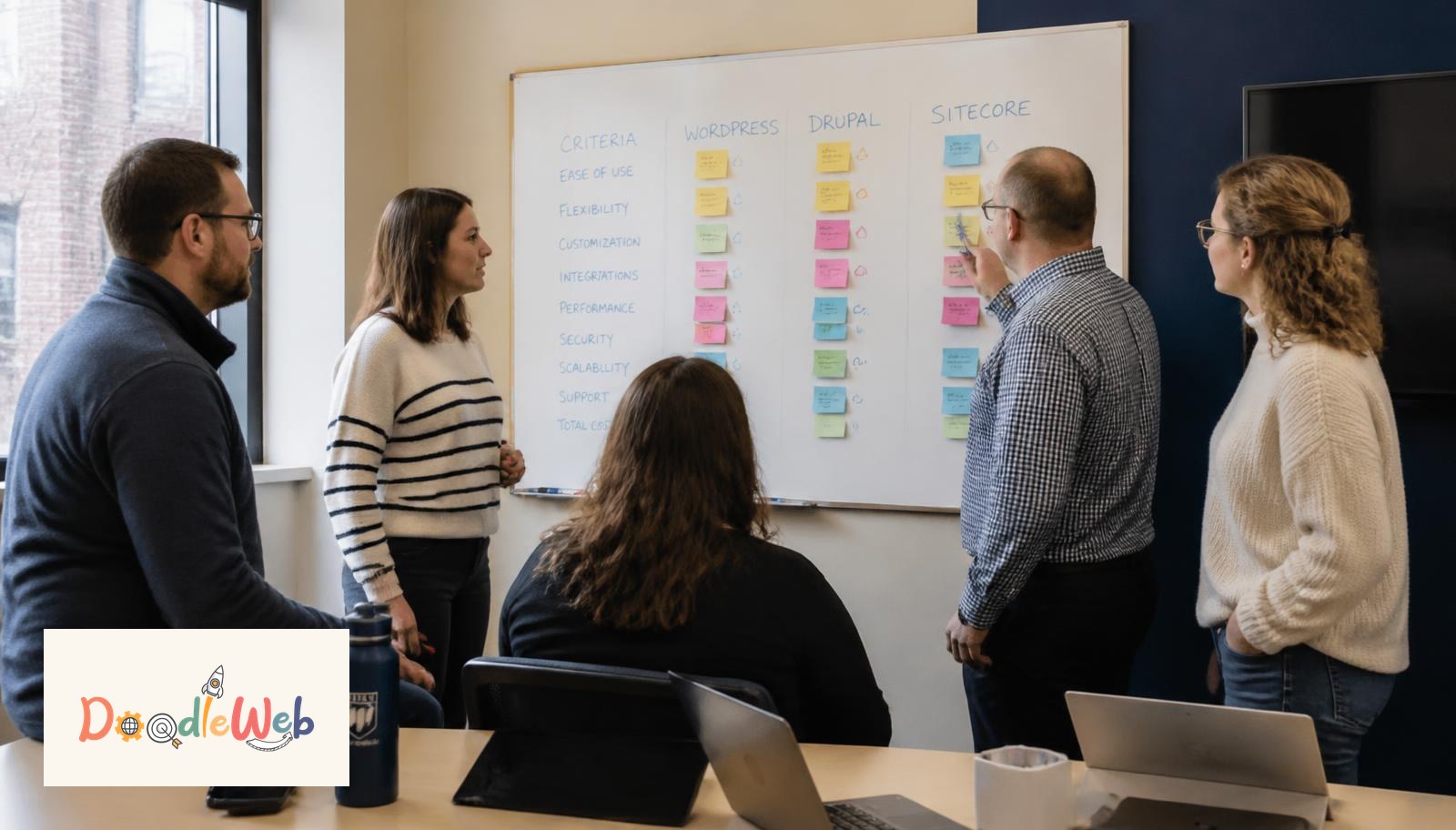

Every agency page claims nonprofit experience. Very few can show a donation flow they improved with numbers attached. This comparison breaks the market into the four types of vendors nonprofits actually choose between, what each costs, and the scorecard we hand clients when they are holding three proposals and no way to compare them.
Which type of agency is right for a nonprofit website?
| Vendor type | Typical project cost | Strongest at | Weakest at |
|---|---|---|---|
| Freelancer or two-person shop | $6k to $25k | Speed, budget fit, personal attention | Bandwidth, accessibility depth, continuity |
| Boutique senior agency (5 to 20 people) | $25k to $120k | Strategy plus build, senior attention, long-term care | Capacity for very large multi-site systems |
| Large agency (50+ people) | $120k to $500k | Multi-site systems, formal process, procurement comfort | Junior staffing after the pitch, slower cycles |
| Nonprofit software platform | $5k to $40k/yr | Fast start, donation tooling included | Design constraints, data portability, thin SEO |
Most organizations under $25M in revenue land with a boutique senior agency or a strong freelancer, and the deciding factor is usually who can keep the site healthy in year two.
How should we score the proposals we already have?
Score each vendor 1 to 5 against these weights, then multiply. It removes the halo effect of a nice deck.
| Criterion | Weight | What a 5 looks like |
|---|---|---|
| Comparable nonprofit work | 20% | Two live sites in your revenue band with measurable results |
| Donation and conversion skill | 20% | Before-and-after conversion numbers, not screenshots |
| Accessibility commitment | 15% | WCAG 2.2 AA in the contract with manual testing |
| Who actually does the work | 15% | Named senior people, not "a team to be assigned" |
| Maintenance and SLA | 15% | Written response times, documented update process |
| Total five-year cost | 10% | Full picture: build, hosting, licenses, care |
| Ownership and exit | 5% | You own code, content, hosting, and analytics |
If a vendor cannot name the person who will write your code, you are buying a sales process, not a team.
What should each phase cost?
| Phase | Share of budget | Notes |
|---|---|---|
| Discovery and content strategy | 10% to 15% | Cutting this is the most common false economy |
| Design and accessible component system | 20% to 25% | Should include mobile-first donation screens |
| Build and integrations | 30% to 40% | CRM, payment, email, event systems |
| Content migration | 10% to 20% | Price by page count and complexity |
| Training and documentation | 5% to 10% | Recorded sessions, written runbook |
| Launch, testing, contingency | 5% to 10% | Accessibility audit lives here |
A proposal with 60% of the budget in "design and development" and nothing named for migration or training is not a plan, it is an estimate.
What questions expose a weak fit?
- Which of your last five nonprofit sites are still live and unchanged?
- What is your team's turnover on accounts like ours?
- What does month 13 look like after the warranty ends?
- How do you handle donor data and PCI scope?
- Can we speak with a client who left you?
That last one is the honest test. Confident shops have an answer.
How do we compare quotes that look wildly different?
Normalize them first. Put every proposal into the same table: page count migrated, number of templates, integrations named, accessibility standard, training hours, warranty length, and annual care cost. Most $28k versus $74k gaps collapse once you see that one quote covers 12 templates and 400 migrated pages and the other covers 4 templates and "content entry by client."
What about agencies that specialize only in nonprofits?
Specialization helps with sector fluency, donation patterns, and grant reporting. It can hurt on technical depth if the shop only builds one platform. A generalist team with real nonprofit references and strong engineering usually outperforms a sector-only shop that ships the same template to everyone. Judge the work, not the vertical claim.
What does DoodleWeb do differently?
We staff senior people only, we put the accessibility standard in the contract, and we hand over full ownership of code, hosting, and analytics on day one. Our nonprofit work focuses on donation flow performance, accessible component systems, and maintenance that keeps a site fast years after launch. You can see how we scope and price work on our pricing page and review our case studies.
What is a reasonable timeline?
- Small site rebuild: 6 to 10 weeks
- Program-heavy site: 12 to 20 weeks
- Platform migration with CRM integration: 16 to 28 weeks
Add four weeks to any timeline where content is written by a committee, which is most of them.
Where to go next
Take your current proposals, run them through the scorecard above, and ask each vendor the five questions. The ranking usually changes, and the conversation gets much more concrete.
Related reading: what nonprofits should look for in website development, questions to ask a nonprofit web agency, and how to fix nonprofit websites in 2026. Ready for a written scope? Contact us.
Director of Growth · Seattle, WA
David works with nonprofit and higher-ed marketing teams on conversion, donation flows, and search visibility. He spends most of his week in analytics, donation funnels, and vendor scorecards.