
Google Business Profile photos are rarely treated as an algorithmic asset. Most service business owners treat their photo gallery like a junk drawer, uploading a low-resolution logo, an exterior shot of an office nobody visits, and maybe a stock photo of a technician shaking hands.
That approach leaves local pack rankings on the table.
In competitive Puget Sound service categories like heat pump installation in Ballard, commercial plumbing in SODO, or architectural remodeling in Queen Anne, local pack placement comes down to behavioral signals and geographic relevance. Google's Vision AI analyzes your image uploads for entities, text, geodata, and visual cues.
If your photos look generic, Google treats your business as generic. Here is the operational photo playbook we implement for Seattle service businesses looking to capture local search visibility.
Why do Google Business Profile photos impact local rankings?
Photos do not just show customers that you exist. They feed Google structured contextual signals that confirm what you do and where you work.
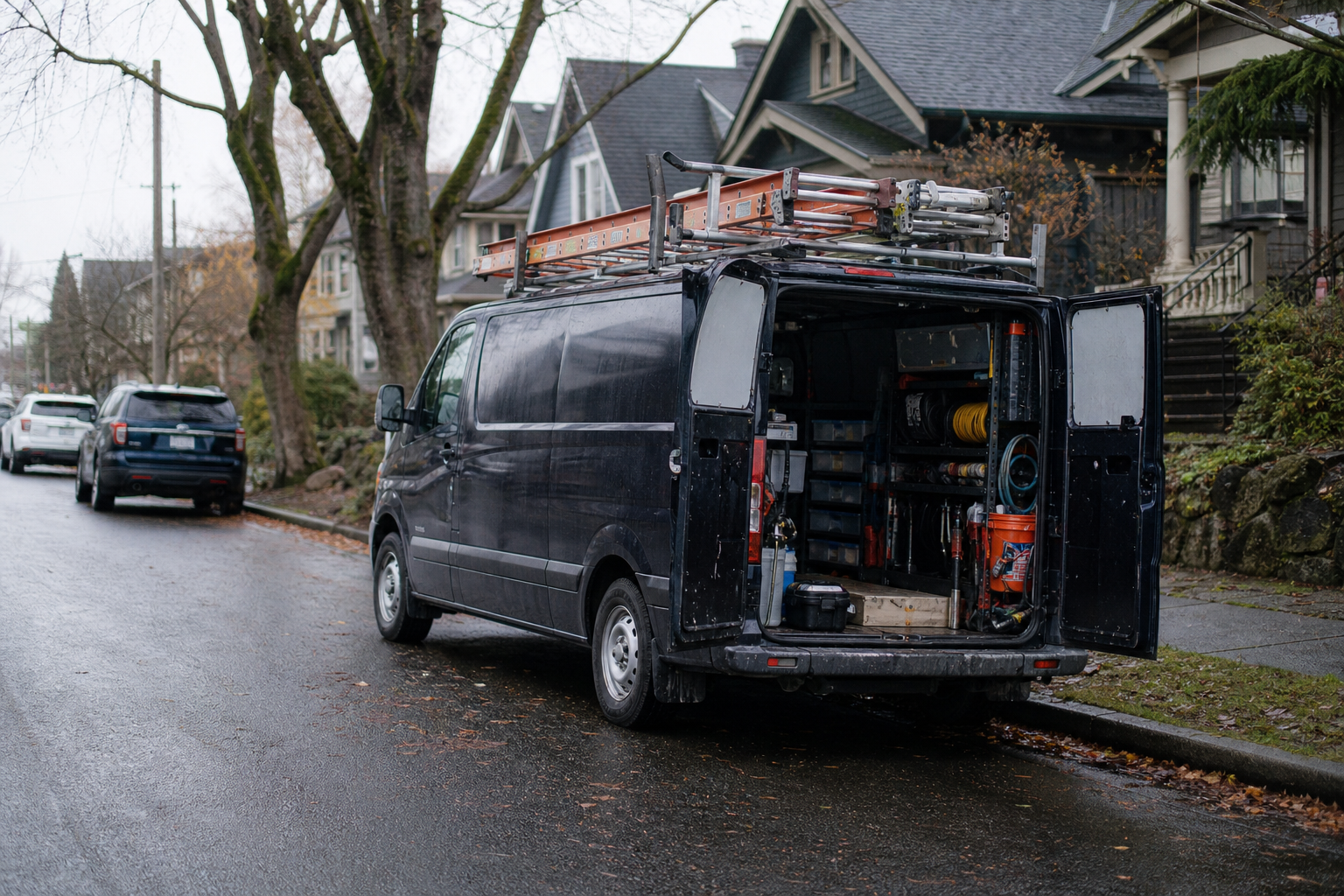
Google runs images through Cloud Vision AI to detect labels, objects, and text. When you upload a photo of a branded van parked along a steep street in Magnolia with a legible company phone number and license plate, Google extracts those entities. It pairs that visual information with your service category and address.
Photos also dictate engagement metrics. Listings with higher click-through rates and regular photo engagement earn more impressions in the Google Maps three-pack. A homeowner searching on their phone for emergency electrical repair wants immediate visual proof of competence, not a sterile vector graphic.
What types of photos does Google actually reward?
Stock photography is worse than useless on your profile. Google detects stock images instantly, and knowledgeable users scroll right past them. Your gallery should look like an honest documentary of your operation across King, Pierce, and Snohomish counties.
Focus your production on five core image categories:
- Branded fleet and equipment on location: Clean photos of your work vehicles parked on distinct Seattle residential streets, commercial loading docks, or outside recognizable local architectural styles.
- Active team members at work: Unstaged shots of technicians, craftspeople, and project leads working on real jobsites with safety gear and company uniforms visible.
- Before and after progress sequences: Pairings that clearly demonstrate the scope of your work, particularly for trades, remodeling, landscape architecture, and restoration services.
- Legible licensing and certifications: Decals on work vans, municipal permit notices posted on site, and framed trade credentials.
- Tools of the trade: High-quality detail shots of specialized equipment, diagnostics screens, or fabrication benches inside your shop.
An image of your team installing a ductless mini-split in a 1920s Phinney Ridge craftsman tells Google and prospective buyers more than ten generic marketing graphics ever could.
How should you handle geodata and metadata?
There is an old SEO myth that manually stuffing EXIF latitude and longitude coordinates into stock photos will fool Google into ranking you across an entire metro area. It does not work. Google ignores spoofed metadata and penalizes blatant manipulation.
However, authentic geodata created naturally by modern smartphones and digital cameras still carries weight when combined with surrounding contextual signals.
When your crew takes photos on site with location services enabled on their company phones, the resulting file contains natural timestamps and genuine geographic coordinates. Do not strip this data using aggressive web compression tools before uploading.
Keep original file names descriptive before you upload. Instead of IMG_4092.jpg, rename the asset to describe the specific service and neighborhood, such as panel-upgrade-residential-west-seattle.jpg. It takes ten seconds and reinforces the contextual topic.
What is the right upload cadence for service companies?
Uploading eighty photos on a rainy Tuesday in January and then ignoring your profile until October signals dormancy. Google values consistency over volume.
Aim for three to five new, original photos uploaded every single week. This steady cadence shows Google that your business is active, operational, and regularly servicing customers in your market.
Make photo collection part of your field team's standard operating procedure. When a technician finishes a job in Kirkland or wraps a project in Columbia City, their closeout checklist should require three photos uploaded directly to a shared company folder:
- One wide shot showing the completed installation or service area.
- One detail shot showing craft quality or equipment branding.
- One exterior shot showing your branded vehicle parked on site.
Your marketing coordinator can review, rename, and upload these images each Friday morning. Over six months, this creates an active gallery of more than a hundred geotagged, entity-rich visual proof points that outclasses dormant competitors.
How do customer photos factor into your strategy?
Photos uploaded by real clients carry distinct algorithmic trust. When a verified customer leaves a Google review and attaches two photos of their newly tiled bathroom in Capitol Hill, Google gives that review and those images higher weight.
Encourage photo attachments directly in your post-service review generation sequence.
When you send an SMS or email asking for feedback after completing a job, specify that photos help small businesses demonstrate their work to neighbors. Homeowners are often proud of major home improvements, clean installations, or commercial buildouts and are happy to show them off.
Monitor user-uploaded images inside your dashboard monthly. If an irrelevant image or a competitor prank gets attached to your listing, flag it immediately for removal through Google's business support portal.
Building local authority requires systematic execution
Local search performance in the Pacific Northwest requires attention to operational details that most agencies skip. Optimizing your Google Business Profile photo pipeline bridges field operations with algorithmic relevance, giving your business an edge in high-value local pack results.
If you want an honest review of your local search presence and technical foundation, request a free review from our team through our free website audit report, or reach out directly via our contact page to discuss your growth plans.

Founder & Lead Strategist · Seattle, WA
Chandan Sharma co-founded DoodleWeb in Seattle and leads its AI search visibility work, including the SiteSonar platform.
Reviewed by Chandan Sharma