
Your Google Business Profile is your most important local SEO asset. For a Seattle service-area business—a plumber, an electrician, a roofer, a landscaper—your GBP photos are not just decoration. They are your digital storefront, the primary way you prove you do high-quality work in the neighborhoods you serve.
A steady stream of authentic photos builds trust with potential customers and signals your activity to Google. Both are critical for generating leads.
What Kind of Photos Should I Post?
Think in categories. You need to show who you are, what you do, and where you do it. Generic stock photos do not work. Customers can spot them instantly, and they erode trust.
Your goal is to build a library showing real work, real people, and real Seattle-area locations.
- Photos of Your Team: We need to see the owner and the team. These should not be sterile corporate headshots. Show your team in their element: wearing company gear, standing by a branded truck, or working on a job site. A picture of your crew at a completed project in Ballard is more powerful than a studio portrait.
- Photos of Your Work: This is the most important category. Document every stage of your work. For a landscaper, that means before, during, and after shots of a garden renovation in a Bellevue backyard. For a roofer, it’s the old roof, the new underlayment, and the finished product with the Cascade mountains in the background. Capture the details that signal quality.
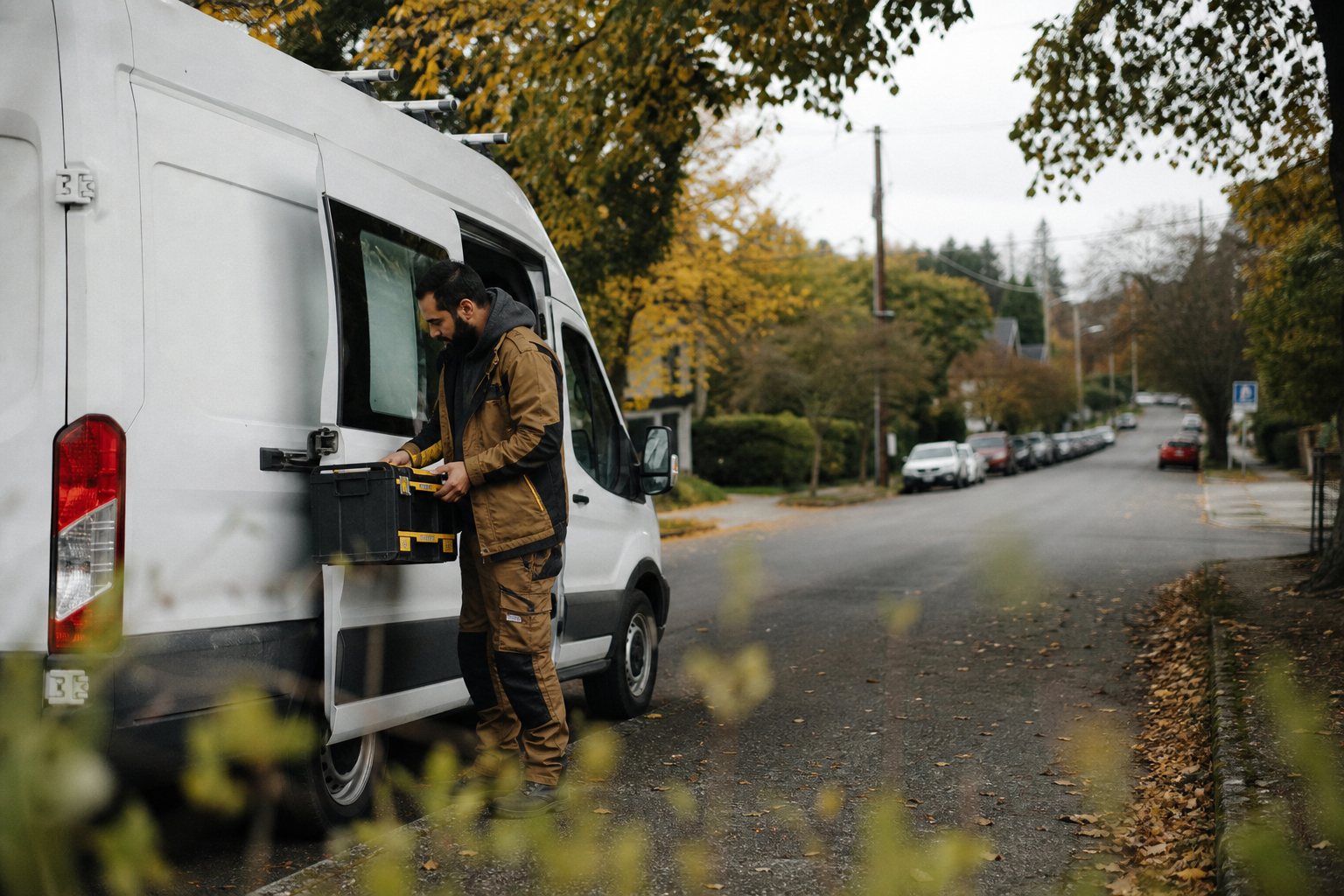
- Photos of Your Vehicles: Your branded work van or truck is a mobile billboard. Photos of It parked in front of a job site in Capitol Hill, Queen Anne, or Tacoma prove you are active in those communities. It’s simple, tangible proof of your service area.
How Do I Prove I’m a Local Seattle Business?
Showing your work in specific locations is key. It tells customers and Google that you are a legitimate local operator.
First, ensure your phone’s camera has location services enabled. This embeds GPS data into each photo file (geotagging). When you upload these photos to your GBP, Google can see the image was taken in a specific location, like West Seattle or Fremont.
Second, use your photo captions. Don’t just upload IMG_4055.jpg. Name your files descriptively, like new-deck-construction-magnolia-seattle.jpg. When you upload to GBP, add a description: "Completed this new cedar deck for a client in Magnolia."
Context is everything. A photo of a freshly paved driveway is good. A photo of that same driveway with the distinctive brick of a Pioneer Square building in the background is better. It firmly roots your work in the city.
Your Google Business Profile photos are not a gallery; they are proof. They prove you are a real, local business doing quality work for your Seattle-area neighbors.
What Are the Technical Photo Guidelines?
Don’t get bogged down in technical details. Follow these simple rules.
- Format: Use JPG or PNG files.
- File Size: Keep files between 10KB and 5MB.
- Resolution: A minimum of 720px by 720px is a good standard.
- Naming: Name your files with descriptive keywords before uploading (e.g.,
kitchen-remodel-wallingford-seattle.jpg).
Consistency is more important than perfection. A clear smartphone photo taken on a typical overcast Seattle day is better than no photo at all.
How Often Should I Add New Photos?
Add photos regularly. Aim for at least one new photo per week, or a small batch of photos after you complete each significant project.
This activity shows Google your business is active and current. It also consistently provides fresh content for potential customers browsing your profile.
An effective photo strategy is one of the highest-return, lowest-cost investments you can make in your local SEO. It requires consistency, not a professional photographer. Just document your work and show Seattle where you do it.
Ready to get more from your web presence? Request our /free-website-audit-report.
Seattle agency · Seattle, WA
A full-service digital agency working in WordPress, Drupal, Shopify, Webflow, React, and React Native. We partner with universities, nonprofits, governments, and growing brands to ship sites that hold up after launch.