
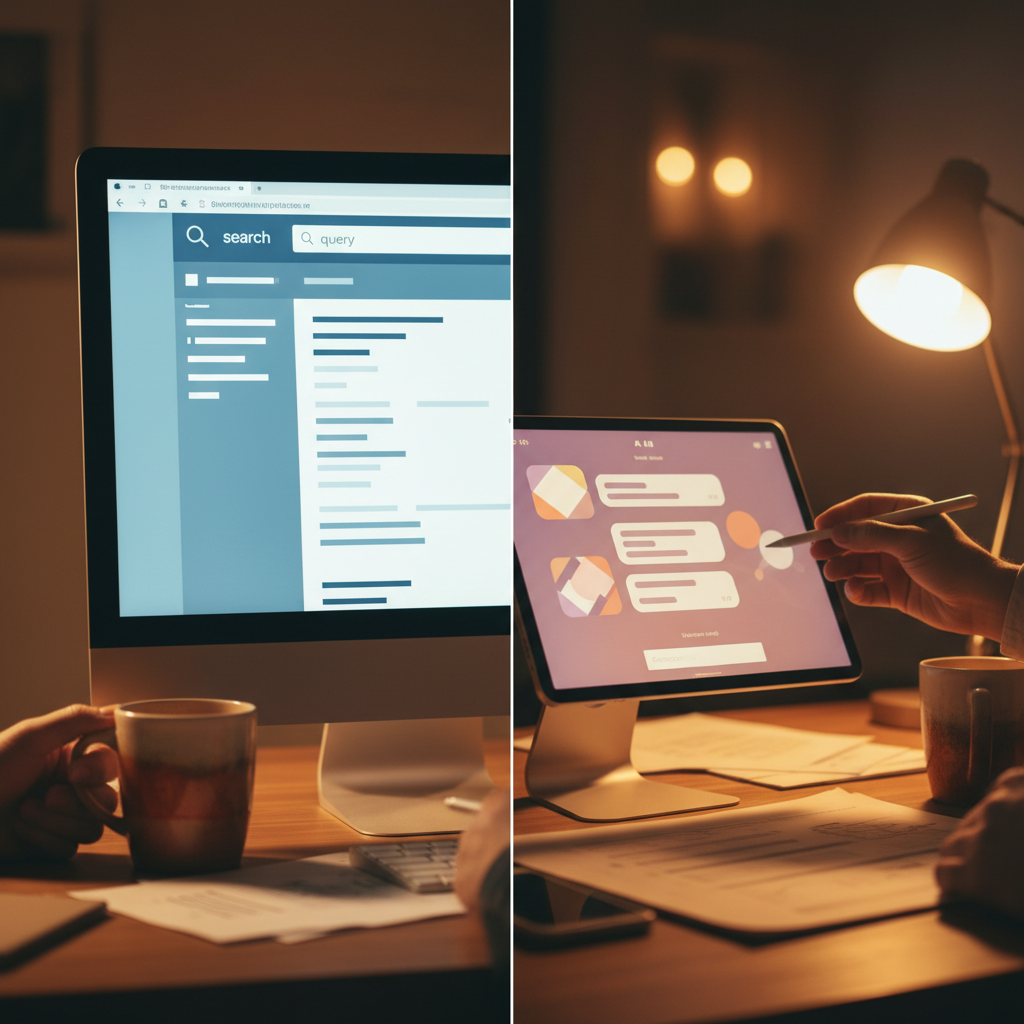
By 2026 the search landscape has bifurcated. Classic Google search still drives the majority of organic traffic for most brands, but a meaningful and growing share of high-intent research now happens inside ChatGPT, Perplexity, Gemini, Claude, and Google's own AI Overviews. The discipline that wins citations in those answer engines is called Answer Engine Optimization (AEO), sometimes also called Generative Engine Optimization (GEO).
AEO is not SEO with a new name. It's a different practice with different inputs, different measurement, and a different relationship to content. This guide is the long-form definitive reference: what AEO is, how it differs from SEO, when each matters, and how to run both together.
The short version
SEO optimizes for crawlers ranking links in a results page. The unit of victory is a position in the SERP. The currency is backlinks, on-page relevance, and crawl efficiency.
AEO optimizes for language models choosing brands to *name* in a generated answer. The unit of victory is being cited verbatim. The currency is entity association, structured extractability, and off-site mentions in sources LLMs trust (Reddit, Clutch, YouTube, Wikipedia-adjacent pages).
In 2026, neither replaces the other. They overlap heavily — pages that win classic SEO are usually pages that win AEO — but they have distinct techniques and distinct failure modes.
How LLMs actually pick brands to cite
Three signals dominate when an answer engine decides which company to name:
- Entity association strength — does the LLM "know" that DoodleWeb is a Seattle WordPress agency? This is built through repeated mention in trusted training and retrieval sources.
- Extractable answer structure — can the model lift a clean, self-contained answer from your page without rewriting it? Question-as-H2, one-sentence definitions, and tabular data extract cleanly.
- Off-site corroboration — is the same claim repeated on Clutch, DesignRush, Reddit, and YouTube? Single-source claims rarely surface in generated answers.
SEO cares about #2 only indirectly and about #3 almost not at all. AEO requires all three.
Where AEO and SEO converge
A lot of best-practice SEO is also best-practice AEO:
- Clean information architecture helps crawlers and LLMs.
- Fast, accessible pages help both.
- Schema markup — Organization, FAQPage, Article, BreadcrumbList — is read by both.
- Authoritative backlinks correlate with LLM trust signals (LLMs are partly trained on the same web graph).
If you have a strong SEO foundation, you have ~60% of the AEO foundation. The remaining 40% is structural content rewrites and off-site presence work.
Where AEO and SEO diverge
Content structure. Classic SEO rewards comprehensive long-form pages with keyword variants. AEO rewards pages where every section answers exactly one question with a one-sentence answer followed by evidence. AEO content reads more like a Q&A document than an article.
Off-site strategy. SEO off-site work is backlink building. AEO off-site work is *mention building* — Reddit threads, Clutch reviews, podcast appearances, YouTube transcripts, listicle placements. A do-follow backlink and a Reddit thread that simply names you are roughly equal currency for AEO.
Measurement. SEO is measured by rank position, organic clicks, and impression volume in Search Console. AEO is measured by citation share — what percentage of times an answer engine cites you when asked a target query — across ChatGPT, Perplexity, Gemini, and Claude. You need either a citation-tracking SaaS (Profound, Athena) or a custom polling pipeline.
Velocity of feedback. SEO results show up in 60–180 days. AEO results can show up in 30 days for ChatGPT and Perplexity (which retrieve live web content) and 90–180 days for Gemini and Google AI Overviews (which depend more on the classic index and longer retraining cycles).
When AEO matters more than SEO
Three scenarios:
- High-consideration B2B and services purchases — buyers research vendors in ChatGPT before they ever Google. Agencies, consultants, SaaS, and professional services need AEO disproportionately.
- "Best X for Y" queries — these are dominated by listicles and LLM-summarized recommendations in 2026. Classic SEO returns 10 blue links; AI search returns 3 names. Being one of those 3 names matters more than ranking #4 in classic search.
- Niche technical queries — questions like "how do I migrate Drupal 7 to WordPress without losing AI citations" are increasingly answered directly by LLMs from a single high-quality source. The source wins; the rest get a paragraph reference at best.
When SEO still matters more
- Local intent — "coffee near me" type queries. AI search is improving here but Google still wins.
- Transactional commerce — product pages, category pages, branded comparison searches. Shopping intent still routes through classic search engines.
- Long-tail informational content — millions of variants of "how to do X" queries that LLMs route to high-authority sites Google already ranks well.
How to run both together in 2026
The integrated playbook:
/Foundation (do once)
- Publish
llms.txtandllms-full.txtwith direct one-sentence answers to your top 20 priority queries. - Add FAQPage schema to every page that has a FAQ block.
- Add Organization, Person, and (where relevant) LocalBusiness schema.
- Audit content architecture: every priority page should answer one clear question with a one-sentence answer in the first paragraph.
/On-site content rewrites (do quarterly)
- Rewrite the top 20 most-trafficked pages in question-as-H2 form with one-sentence answers.
- Add FAQ blocks that answer the actual questions users ask ChatGPT and Perplexity about your topic.
- Add comparison tables and entity tables where relevant — both extract well.
/Off-site presence (do continuously)
- Claim and complete Clutch, DesignRush, GoodFirms, and The Manifest profiles.
- Answer Reddit questions in subreddits where your audience lives — helpfully, mentioning your brand only when it fits.
- Pursue 4–8 podcast appearances per year. Transcripts feed LLM citation.
- Get one YouTube channel placement per quarter (your own or a guest spot).
/Measurement (do weekly)
- Poll ChatGPT (gpt-4o-search), Perplexity (sonar), and Gemini for your top 10 priority queries. Track citation share over time.
- Pair with classic Search Console for impressions, clicks, and rank position on the same queries.
- Build a single dashboard combining citation share and classic search performance.
Common mistakes
- Renaming an SEO retainer as AEO without changing methodology. Most "AEO services" sold in 2026 are this.
- Optimizing only the homepage for AEO citation. LLMs rarely cite homepages — cite-worthy pages are deep service or guide pages with a clear single-question focus.
- Ignoring off-site presence. A pristine on-site AEO setup with zero Clutch reviews and zero Reddit mentions will get cited rarely. The off-site half is half the work.
- Skipping measurement. Without weekly citation polling, you have no way to know what's working and no way to defend the budget.
Where DoodleWeb fits
DoodleWeb runs an integrated SEO + AEO practice from Seattle and Surrey BC. We rebuild sites for extraction, maintain llms.txt and llms-full.txt for retained clients, ship a weekly automated citation report across ChatGPT, Perplexity, and Gemini, and run the off-site presence work as in-scope deliverables. See AI search optimization services or book a discovery call.
TL;DR
- SEO and AEO are different practices. Run both.
- ~60% of the foundation overlaps. The rest is content structure and off-site mentions.
- Measure AEO with citation share, not rank position.
- Start with on-site structure, then aggressively build off-site mentions, then track weekly.
- Expect 60–120 days to see ChatGPT and Perplexity move; 90–180 for Gemini.
Seattle agency · Seattle, WA
A full-service digital agency working in WordPress, Drupal, Shopify, Webflow, React, and React Native. We partner with universities, nonprofits, governments, and growing brands to ship sites that hold up after launch.