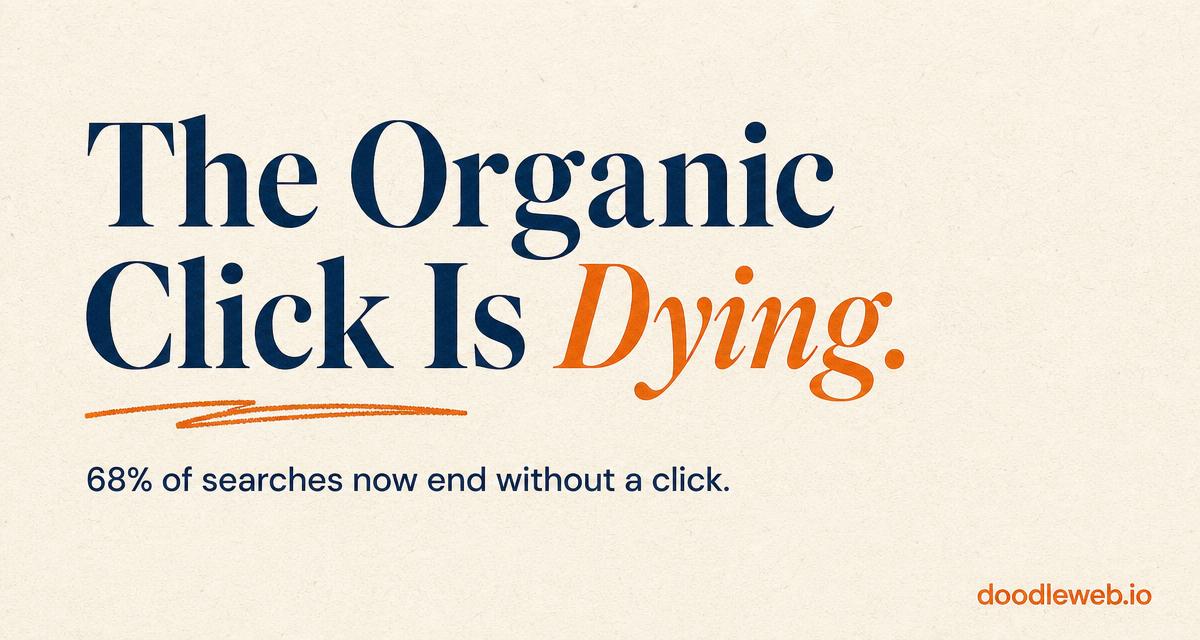
Zero-click search means a Google search that ends without the user clicking any result, because the answer appears directly on the results page. In 2026, 68% of U.S. Google searches end this way, which means most businesses are losing traffic even when their rankings have not moved.
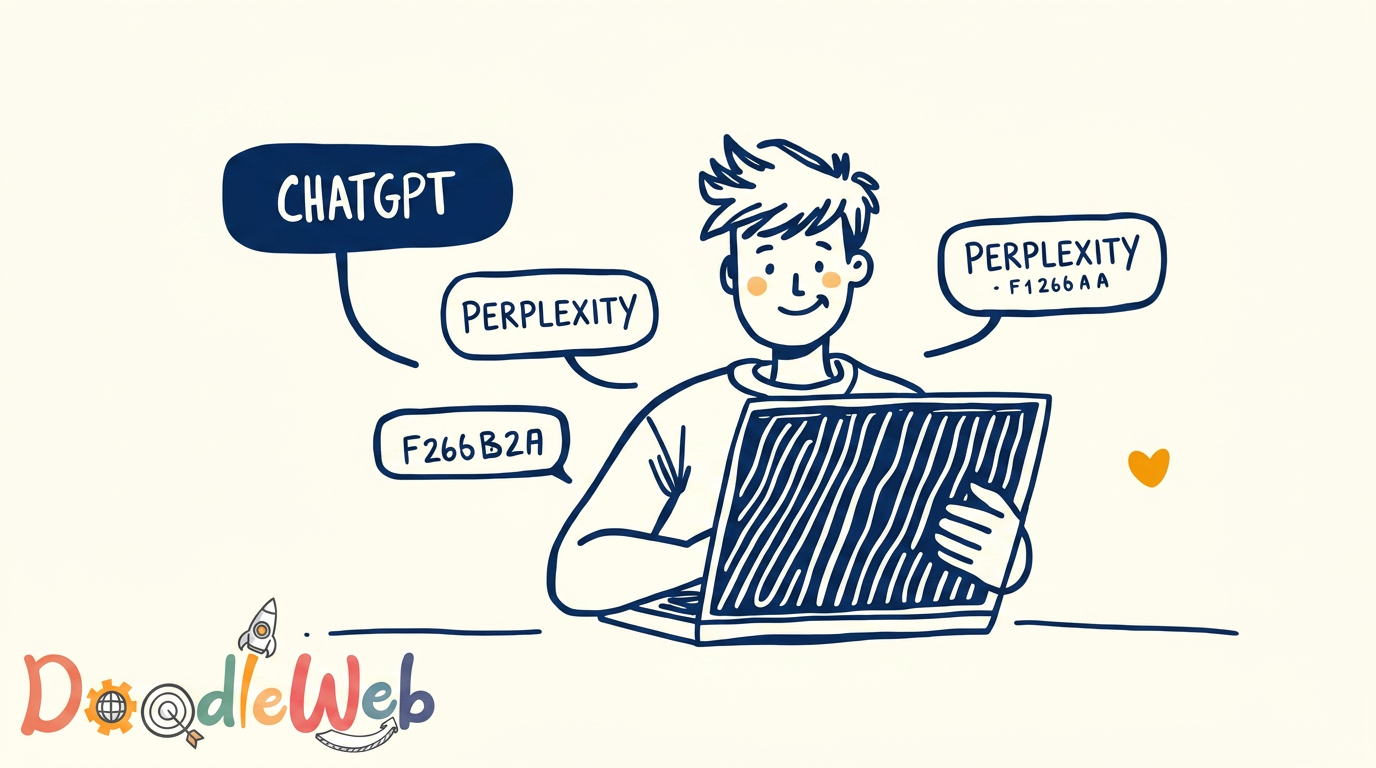
This shift is driven by Google AI Overviews, Google AI Mode, and standalone AI assistants like ChatGPT and Perplexity answering questions before anyone reaches a website. This guide explains what changed, what the data shows, and the exact steps a business can take to stay visible when answers replace links.
Key takeaways
- 68% of U.S. Google searches now end without a single click (SparkToro / Similarweb, 2026).
- When an AI Overview appears, organic click-through rates fall from 1.76% to 0.61%, a 65% decline (Seer Interactive).
- In Google's AI Mode, the zero-click rate reaches 93%.
- The overlap between ranking in Google's top 10 and being cited in AI Overviews collapsed from roughly 75% in mid-2025 to 17-38% in early 2026.
- Visitors who arrive from AI tools convert at roughly 4.4x the rate of traditional organic visitors (Semrush).
- Brands cited inside AI Overviews earn about 35% more organic clicks than uncited brands on the same query.
What is zero-click search?
Zero-click search is a search that ends on the results page itself: the user gets their answer from an AI Overview, featured snippet, knowledge panel, or map pack and never visits a website. The behavior is not new, but AI answers accelerated it sharply. A decade ago roughly 45% of Google searches were zero-click; today it is 68%, and Pew Research found that when an AI Overview appears, about 26% of users end their browsing session entirely.
The 2026 numbers every business should know
| Metric | Value | Source |
|---|---|---|
| U.S. Google searches ending without a click | 68% | SparkToro / Similarweb, 2026 |
| Organic CTR when an AI Overview appears | 1.76% down to 0.61% | Seer Interactive |
| Zero-click rate in Google AI Mode | 93% | Industry analyses, 2026 |
| Share of queries triggering AI Overviews | ~48% | BrightEdge, Feb 2026 |
| Users ending their session after seeing an AI Overview | 26% | Pew Research Center |
| Top-10 ranking to AI citation overlap | 75% in 2025 down to 17-38% in 2026 | ALM Corp / BrightEdge |
| Conversion rate of AI-referred visitors vs organic | ~4.4x higher | Semrush |
| Extra organic clicks for brands cited in AI Overviews | +35% | Seer Interactive |
| ChatGPT search volume | 1B+ searches per week | OpenAI, 2026 |
Why ranking #1 no longer guarantees visibility
Ranking and being cited by AI are now two different games. In mid-2025, about 75% of the pages cited in AI Overviews also ranked in Google's top 10 for that query. By early 2026 that overlap had collapsed to between 17% and 38%, and BrightEdge measured a 400% increase in citations pulled from results ranked in positions 21-30. In practice, this means a business can hold its rankings, keep its impressions, and still watch leads decline, because AI assistants are recommending companies that never appear on page one. Traditional SEO reports measure the old game.
The good news: fewer clicks, better clicks
The clicks that survive are worth more. Semrush found that visitors referred by AI tools convert at roughly 4.4x the rate of traditional organic visitors, because the AI has already answered their basic questions and effectively made an introduction. Brands cited inside AI Overviews also earn about 35% more organic clicks than uncited competitors on the same query. The market is not shrinking so much as redistributing: attention is moving from ranked links to cited brands.
How to stay visible in AI search: a 6-step playbook
/1. Answer the question in the first two sentences
AI systems extract direct answers. Open every important page and section with a plain-language answer to the question the heading poses, then add depth below it.
/2. Keep your brand facts identical everywhere
Your business name, address, services, and founder details must match exactly across your website, schema markup, Google Business Profile, LinkedIn, and directory listings. Conflicting facts make AI systems less confident citing you.
/3. Use structured data on every key page
Publish Organization, Service, Article, and FAQPage JSON-LD. Structured data is how machines confirm what your pages claim.
/4. Structure content for machines as well as people
Use descriptive H2/H3 headings phrased as questions where natural, real HTML tables for data, bulleted lists for steps, and FAQ sections on service pages.
/5. Earn mentions on the sources AI reads
AI assistants weigh third-party corroboration: industry publications, review platforms, directories, and news coverage. Off-site mentions are the new backlinks.
/6. Measure AI citations monthly, not just rankings
Ask ChatGPT, Perplexity, and Gemini the questions your buyers ask, and track whether your brand appears in the answers. Treat citation share the way you used to treat rankings.
How to measure your AI visibility
Most businesses have never checked what AI actually says about them. We built SiteSonar to do exactly this: it scans ChatGPT, Gemini, and Google AI Overviews across the questions buyers ask in your category and reports where you are cited, where competitors are cited instead, and what to fix first.
Frequently asked questions
/What is zero-click search?
Zero-click search is a search that ends without the user clicking any result, because the answer appears directly on the results page through an AI Overview, featured snippet, or knowledge panel. In 2026, about 68% of U.S. Google searches are zero-click.
/Is SEO dead in 2026?
No. SEO is not dead, but its goal has changed. Traditional rankings still matter for the searches that produce clicks, while a growing share of visibility now comes from being cited inside AI-generated answers, which requires answer-first content, structured data, and consistent brand facts.
/What is the difference between SEO, AEO, and GEO?
SEO (search engine optimization) targets ranked links in traditional search results. AEO (answer engine optimization) targets direct answers such as featured snippets and AI Overviews. GEO (generative engine optimization) targets citations inside AI assistants like ChatGPT, Perplexity, and Gemini. Most businesses in 2026 need all three working together.
/How do I get my business cited in AI Overviews and ChatGPT?
Publish content that answers specific questions directly in the first two sentences, add FAQPage and Organization structured data, keep your business facts identical across the web, and earn mentions on the third-party sites AI systems read. Then test monthly by asking AI tools the questions your customers ask.
/Do AI Overviews reduce website traffic?
Yes, for most informational queries. When an AI Overview appears, organic click-through rates drop about 65%, and roughly 26% of users end their session entirely. However, brands that are cited inside AI answers earn about 35% more clicks than uncited brands, and AI-referred visitors convert at roughly 4.4x the rate of traditional organic visitors.
/How can I check what AI says about my business?
Ask ChatGPT, Perplexity, and Gemini the questions your buyers ask, such as "who is the best [your service] company in [your city]," and note which brands are named. Tools like SiteSonar automate this by scanning AI platforms across your category's key questions and reporting your citation share monthly.
Find out if AI knows you exist
We'll scan ChatGPT, Gemini and Google AI for your brand and send you the report. No pitch.
Book a free AI visibility scan
Seattle agency · Seattle, WA
A full-service digital agency working in WordPress, Drupal, Shopify, Webflow, React, and React Native. We partner with universities, nonprofits, governments, and growing brands to ship sites that hold up after launch.