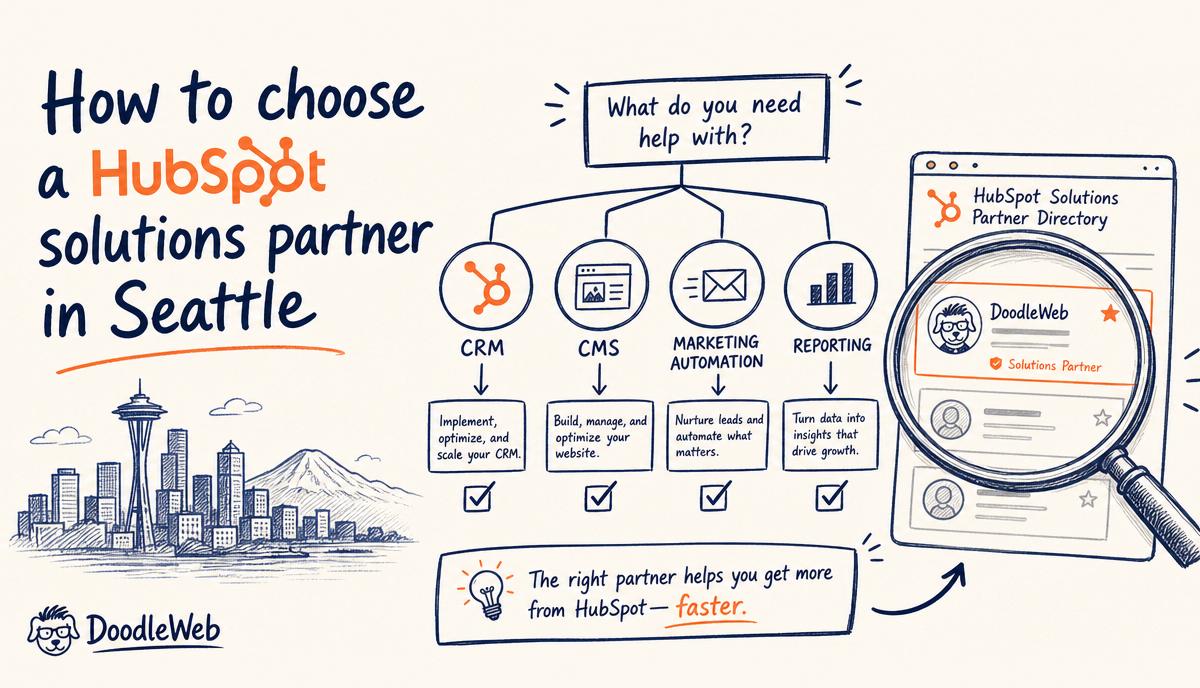
HubSpot's partner program has five tiers: Solutions, Gold, Platinum, Diamond, and Elite. The short answer is that tier reflects sold monthly recurring revenue and retention, not the quality of any given project. Fit, senior team access, and industry experience matter more when you're picking a partner for real work.
What each tier actually signals
HubSpot ranks Solutions Partners by three main inputs: sold MRR (net new HubSpot revenue the partner has closed), retention (do those customers stay on HubSpot), and platform breadth (how many Hubs the partner delivers). Tier is recalculated on a rolling basis, so a partner's badge can move quarter to quarter.
Here is how the tiers stack up in practice for a 2026 buyer.
| Tier | Sold MRR (rough) | What it signals | Typical fit |
|---|---|---|---|
| Solutions | Any active partner | Certified, in good standing, on the ladder | Smaller onboardings, single-Hub projects |
| Gold | $2K+ MRR | Consistent sales momentum, multi-Hub delivery | Mid-market implementations |
| Platinum | $6K+ MRR | Serious HubSpot practice with retention | Multi-Hub, migrations, integrations |
| Diamond | $18K+ MRR | Established enterprise practice | Complex enterprise, cross-portal work |
| Elite | Very high sold MRR + strict scorecard | Top 1% globally | Global rollouts, deep RevOps programs |
Two important caveats. First, the exact MRR bands shift; HubSpot revises them. Second, the badge does not describe delivery quality on your specific project. A Diamond partner with a great sales team and a stretched delivery bench can ship a worse implementation than a Solutions partner who owns your account personally.
What actually matters more than tier
Here is what to weigh when a partner shortlist lands on your desk.
- Senior team access. Ask who leads discovery, who architects the portal, and who owns the account after go-live. If the answer changes between the pitch and the kickoff, that is your signal.
- Industry experience. A partner who has shipped 20 B2B SaaS portals will spot your data-model mistakes on the first call. A partner whose case studies are all agencies will not.
- RevOps fluency. HubSpot is a revenue system, not a database. Ask how they design lifecycle stages, deal pipelines, and reporting so the C-suite trusts the numbers.
- Integration depth. If your product, warehouse, or ERP has to talk to HubSpot, ask for a specific example. "We use Operations Hub" is not an example.
- Honest scoping. Good partners tell you what they will not do, and what they think is a bad idea. Salespeople who nod at every requirement are the ones you will fight with in month three.
When tier does matter
Tier is a real signal in three cases. Enterprise procurement often requires a Diamond or Elite partner to satisfy a preferred-vendor list. Global implementations benefit from an Elite partner's international bench. And if you want to be sure the partner has survived multiple audit cycles, tier is a lagging proxy for stability.
For everything else, treat the badge as a starting filter, not the decision.
What to do next
If you are early in a HubSpot buying cycle, get the cost picture first — see How much does a HubSpot partner cost in 2026. If you already know you're implementing, the HubSpot onboarding checklist walks through what a good partner runs in the first six weeks. When you're ready to scope, talk to DoodleWeb — we are a HubSpot Certified Partner with senior consultants only.
Seattle agency · Seattle, WA
A full-service digital agency working in WordPress, Drupal, Shopify, Webflow, React, and React Native. We partner with universities, nonprofits, governments, and growing brands to ship sites that hold up after launch.